ITDP India

Promoting sustainable and equitable transportation worldwide

  • Contact
  • ITDP India’s 2025
  • Who We Are
    • Our Approach
    • Contact Us
    • Career Opportunities
  • What We Do
    • Healthy Streets
    • Public Transport
    • Electric Mobility
    • Transit Oriented Development
    • Low Emission Zones
    • Inclusive Mobility
    • Traffic Reduction
  • Where We Work
    • NATIONAL
    • MAHARASHTRA
      • Pune
      • Pimpri Chinchwad
      • Nashik
    • TAMIL NADU
      • Chennai
      • Coimbatore
    • JHARKHAND
      • Ranchi
    • Agra
    • Ahmedabad
  • Blogs
  • Resources
    • Press
  • National Challenges
    • India Cycles4Change Challenge
    • Streets for People Challenge
    • Transport4All Challenge
  • Urbanlogue
    • Urbanlogue Webinars – Series One
    • Urbanlogue Webinars – Series Two
    • Urbanlogue Webinars – Series Three
    • Urbanlogue Webinars – Series Four

Cities in Maharashtra Show Intent for Low Emission Zones, but what are the Legal Options for Implementing them?

21st August 2026 by admin


As Pune prepares to implement a Low Emission Zone (LEZ), an important question lies at the centre of the discussion: how can cities legally regulate high-polluting vehicles?   

Low emission zones (LEZs) are designated zones in a city where the use of polluting vehicles is restricted or discouraged. Such zoning aims to improve local air quality and health by reducing vehicle tailpipe emissions. One pathway to implement LEZ is straightforward restriction – banning old polluting vehicles from entering identified areas. The other is more strategic; using pricing mechanisms to discourage the use of polluting vehicles while also generating resources to support sustainable transport initiatives. 

ITDP India is working with Pune to implement the idea of introducing a charge on high polluting vehicles. Instead of relying solely on bans, the aim is to introduce a levy on older and more polluting vehicles entering the LEZ. How this can be done is simple: create a system where cleaner mobility becomes the easier and more affordable choice. 

However, choosing “pricing” is not just a policy shift. It is also a legal one. 

In order to kick-start a LEZ, the legal pathway used to introduce these charges must be carefully structured. The legislation supporting it, the authority under which the charge is introduced, and terminology used will determine whether the system can withstand legal scrutiny. 

Understanding the Existing Legal Landscape for Clean Air   

India does not currently have a single consolidated law governing Low Emission Zones. Instead, implementation depends on multiple laws and authorities working together. At the constitutional level, the right to a clean environment is recognised under Article 21, while Article 48-A places a duty on the State to protect and improve the environment. 

Beyond this constitutional backing, several legislations create the broader framework within which an LEZ can operate. 

  • The Environment (Protection) Act, 1986 (EPA) grants the Central Government wide powers to regulate polluting activities and restrict certain areas when necessary for environmental protection. 
  • The Air (Prevention and Control of Pollution) Act, 1981 empowers both the State Pollution Control Board and State Government to plan and implement pollution-abatement programmes, including issuing binding directions. 
  • The Motor Vehicles Act, 1988 allows State Governments to regulate vehicle movement in the interest of public safety and convenience. 

Meanwhile, the Maharashtra Municipal Corporations (MMC) Act, 1949 directs municipal corporations to undertake environmental protection measures. However, the Act currently does not explicitly empower the city to levy environmental charges linked to vehicular pollution. 

This gap becomes central when discussing how Pimpri Chinchwad Municipal Corporation (PCMC) and Pune Municipal Corporation (PMC) can independently implement a pricing-based LEZ. 

What are the Possible Legal Pathways for Indian Cities to Introduce Pricing in LEZ 

To better understand how pricing can be introduced within a Low Emission Zone (LEZ), ITDP India conducted a legal study in the context of Pimpri Chinchwad. The objective was to identify the various legal pathways available for introducing a pricing mechanism and assess which of them could provide a legally robust foundation. The study identifies three possible pathways through which an LEZ and its associated pricing mechanism could be implemented. While the analysis was undertaken for Pimpri Chinchwad, these pathways may also be relevant for other cities in Maharashtra, including Pune. However, they should be viewed as potential legal options rather than definitive solutions. Their feasibility will ultimately depend on discussions with the respective city corporation and a detailed assessment of the city’s legal and administrative context. 

Option I: Implementing Pricing underthe Air (prevention and control of pollution) Act 1981)  

Approaching the Maharashtra State Government under the Air Act provides one of the most viable legal pathways for introducing pricing under a Low Emission Zone. As Maharashtra is already declared an Air Pollution Control Area, the State Government can impose targeted restrictions and environmental charges to address air pollution. 

Under the same Act, the Maharashtra Pollution Control Board (MPCB) is empowered to plan and implement pollution-abatement measures, issue binding directions, and collect restitutionary damages linked to environmental harm. Together, these provisions provide a strong legal basis for introducing pollution pricing through an LEZ. 

Option II: Implementing Pricing under the Maharashtra Municipal Corporation Act (MMC), 1949 

This pathway enables greater local autonomy but also presents the greatest legal challenge. Under the MMC Act, municipal corporations such as PMC and PCMC can regulate transit and impose certain special charges, but only after getting approval from General Body. Further, the Act does not provide authority to levy environmental charges linked to vehicular pollution. 

As a result, cities seeking to independently implement a pricing-based Low Emission Zone would require legislative amendments. In Maharashtra, this would involve strengthening Section 208 of the MMC Act. At present, Section 208 permits the levy of special charges primarily in cases involving physical damage to roads or traffic obstruction, but it does not explicitly recognise environmental protection or air pollution control as valid grounds for imposing such charges. 

A stronger legal foundation would require amending the provision to: 

  • explicitly recognise environmental protection and vehicular pollution control as legitimate grounds for regulating vehicle movement and levying special charges 
  • authorise the levy of environmental charges for these purposes through the existing mechanism under the Act, including the requirement for approval by the Corporation. 

Option III: Implementing pricing under the Environment (Protection) Act, 1986 

This pathway relies on action by the Central Government through the Ministry of Environment, Forest and Climate Change (MoEFCC). While it provides a strong legal basis for implementing a Low Emission Zone (LEZ), it is less likely to be pursued directly by a city, as the necessary powers rest with the Central Government. 

The Environment (Protection) Act provides wide-ranging powers to protect and improve environmental quality. In the context of an LEZ, the most relevant provisions include the power to: 

  • restrict areas where certain operations or processes may be prohibited or permitted only subject to safeguards (Section 3(2)(v)) 
  • issue binding directions for the regulation or prohibition of activities contributing to pollution (Section 5) 
  • prescribe environmental standards and stricter emission limits for specific areas through the Environment (Protection) Rules, 1986 

Using these powers, the Central Government could notify an area in Pune or Pimpri Chinchwad as a Low Emission Zone and prescribe restrictions or environmental charges for high-polluting vehicles. Since the necessary statutory powers already exist under the EPA, this pathway would not require amendments to existing legislation.

The Terminology Matters for Low Emission Zones: Fee vs Charge

At first glance, the difference between a “fee” and a “charge” may seem minor. Legally, however, the distinction is critical. 

A fee is generally understood as something charged in return for a service or benefit provided to the payer. However, this creates a challenge for an LEZ. An LEZ does not provide a direct service to the driver entering the zone. Instead, it restricts access in order to protect public health and reduce environmental harm. If the levy is framed as a “fee”, it becomes vulnerable to legal challenges on the grounds that no direct service is being provided. 

This is where the concept of an Environment Compensation Charge (ECC), or a “Special Charge”, becomes important. 

Unlike a fee, an environmental compensation charge is linked to the idea of compensating for environmental harm caused by polluting activities. Judicial precedents already recognise the principle of restitutionary and compensatory damages in environmental matters. Framing the levy this way creates a far more resilient legal foundation for implementation. 

Building Legally Resilient Low Emission Zones in Indian Cities 

As Pune and Pimpri Chinchwad move closer to implementing Low Emission Zones, with Pune starting the preliminary phases from June 2026, the urgency of establishing a legally secure framework continues to grow. 

If immediate implementation is the priority, pathways through the Central Government, State Government, or MPCB currently offer the strongest legal footing. Existing legislation and precedents already support the collection of environmental charges through these routes. 

However, if cities seek greater local control and long-term autonomy, it requires legislative reform. In this process, terminology itself becomes a form of legal protection. Framing the levy as Environmental Compensation rather than a service-based fee could determine whether the city’s efforts withstand future legal scrutiny. 

For a policy designed to improve air quality and public health in the long term, legal resilience will be just as important as technical planning.

Authors: Shreesha Arondekar, with technical input from Parin Visariya 
Project team: Parin Visariya, Siddhartha Godbole 
Editor: Donita Jose 


Frequently Asked Questions

  1. What is a Low Emission Zone? A Low Emission Zone is a designated area where the older, polluting vehicles are either restricted, discouraged, or required to pay a charge to enter. The goal is to improve air quality by reducing vehicle emissions in areas with high pollution levels. 
  2. Will an LEZ affect all vehicles? No. LEZs typically target vehicles based on their emission performance. Cleaner vehicles may be exempt, while older and more polluting vehicles may face restrictions or charges. 
  3. How does a pricing-based LEZ work? Instead of completely banning vehicles, a pricing-based LEZ imposes a charge on vehicles that do not meet specified emission standards. The charge acts as a disincentive for using polluting vehicles, providing flexibility while still influencing travel behaviour. It allows vehicle owners to make choices while creating a financial incentive to shift towards cleaner vehicles or sustainable transport options. 
  4. How can revenue collected through an LEZ be used? The LEZ charge is not designed as a revenue-generating mechanism. The primary intention of levying a charge is to discourage continued use of high polluting vehicles and gradually phase them out. Revenue from LEZ charges will support initiatives that directly reduce air pollution such as investing in procuring electric buses, and improving walking and cycling infrastructure. 
> Annexure

THE ENVIRONMENT (PROTECTION) ACT, 1986 
 
(1) Section 3 
“3. Power of Central Government to take measures to protect and improve environment.— 
(1) Subject to the provisions of this Act, the Central Government shall have the power to take all such measures as it deems necessary or expedient for the purpose of protecting and improving the quality of the environment and preventing, controlling and abating environmental pollution. 
 
(2) In particular, and without prejudice to the generality of the provisions of sub-section (1), such measures may include measures with respect to all or any of the following matters, namely:— 
(i) co-ordination of actions by the State Governments, officers and other authorities— 
(a) under this Act, or the rules made thereunder; or 
(b) under any other law for the time being in force which is relatable to the objects of this Act; 
(ii) planning and execution of a nation-wide programme for the prevention, control and abatement of environmental pollution; 
(iii) laying down standards for the quality of environment in its various aspects; 
(iv) laying down standards for emission or discharge of environmental pollutants from various sources whatsoever: 
Provided that different standards for emission or discharge may be laid down under this clause from different sources having regard to the quality or composition of the emission or discharge of environmental pollutants from such sources; 
(v) restriction of areas in which any industries, operations or processes or class of industries, operations or processes shall not be carried out or shall be carried out subject to certain safeguards; 
(vi) laying down procedures and safeguards for the prevention of accidents which may cause environmental pollution and remedial measures for such accidents; 
(vii) laying down procedures and safeguards for the handling of hazardous substances; 
(viii) examination of such manufacturing processes, materials and substances as are likely to cause environmental pollution; 
(ix) carrying out and sponsoring investigations and research relating to problems of environmental pollution; 
(x) inspection of any premises, plant, equipment, machinery, manufacturing or other processes, materials or substances and giving, by order, of such directions to such authorities, officers or persons as it may consider necessary to take steps for the prevention, control and abatement of environmental pollution; 
(xi) establishment or recognition of environmental laboratories and institutes to carry out the functions entrusted to such environmental laboratories and institutes under this Act; 
(xii) collection and dissemination of information in respect of matters relating to environmental pollution; 
(xiii) preparation of manuals, codes or guides relating to the prevention control and abatement of environmental pollution; 
(xiv) such other matters as the Central Government deems necessary or expedient for the purpose of securing the effective implementation of the provisions of this Act. 
 
(3) The Central Government may, if it considers it necessary or expedient so to do for the purposes of this Act, by order, published in the Official Gazette, constitute an authority or authorities by such name or names as may be specified in the order for the purpose of exercising and performing such of the powers and functions (including the power to issue directions under Section 5) of the Central Government under this Act and for taking measures with respect to such of the matters referred to in sub-section (2) as may be mentioned in the order and subject to the supervision and control of the Central Government and the provisions of such order, such authority or authorities may exercise the powers or perform the functions or take the measures so mentioned in the order as if such authority or authorities had been empowered by this Act to exercise those powers or perform those functions or take such measures.” 
 
(2) Section 5 
“5. Power to give directions — Notwithstanding anything contained in any other law but subject to the provisions of this Act, the Central Government may, in the exercise of its powers and performance of its functions under this Act, issue directions in writing to any person, officer or any authority and such person, officer or authority shall be bound to comply with such directions. 
 
Explanation.—For the avoidance of doubts, it is hereby declared that the power to issue directions under this section includes the power to direct— 
(a) the closure, prohibition or regulation of any industry, operation or process; or 
(b) stoppage or regulation of the supply of electricity or water or any other service.” 
 
(3) Section 6 
“6. Rules to regulate environmental pollution —  
(1) The Central Government may, by notification in the Official Gazette, make rules in respect of all or any of the matters referred to in Section 3. 
 
(2) In particular, and without prejudice to the generality of the foregoing power, such rules may provide for all or any of the following matters, namely:— 
(a) the standards of quality of air, water or soil for various areas and purposes; 
(b) the maximum allowable limits of concentration of various environmental pollutants (including noise) for different areas; 
(c) the procedures and safeguards for the handling of hazardous substances; 
(d) the prohibition and restrictions on the handling of hazardous substances in different areas; 
(e) the prohibition and restrictions on the location of industries and the carrying on of processes and operations in different areas; 
(f) the procedures and safeguards for the prevention of accidents which may cause environmental pollution and for providing for remedial measures for such accidents.” 
 
(4) Section 15 
“15. Penalty for contravention of provisions of Act, rules, orders and directions —  
(1) Where any person contravenes or does not comply with any of the provisions of this Act or the rules made or orders or directions issued thereunder for which no penalty is provided, he shall be liable to penalty in respect of each such contravention which shall not be less than ten thousand rupees but which may extend to fifteen lakh rupees. 
 
(2) Where any person continues contravention under sub-section (1), he shall be liable to additional penalty of ten thousand rupees for every day during which such contravention continues.” 
 
(5) Section 15-C 
“15-C. Adjudicating officer —  
(1) The Central Government, for the purposes of determining the penalties under this Act, may appoint an officer not below the rank of Joint Secretary to the Government of India or a Secretary to the State Government to be the adjudicating officer, to hold an inquiry and to impose penalty in the manner, as may be prescribed: 
 
Provided that the Central Government may appoint as many adjudicating officers as may be required. 
 
(2) The adjudicating officer may— 
(a) call upon any person alleged to have contravened or not complied with the provisions of this Act and the rules made thereunder or having the knowledge of the facts and circumstances of the case; 
(b) require such person to produce any record, register or other document in his possession or any other document, which in the opinion of the adjudicating officer may be relevant to the subject-matter. 
 
(3) The adjudicating officer shall, after giving the person a reasonable opportunity of being heard in the matter, and if, on such inquiry, he is satisfied that the person concerned has contravened or has not complied with the provisions of this Act or the rules made thereunder, he may impose such penalty as he thinks fit in accordance with the provisions of Sections 14-A, 14-B, 15, 15-A or Section 15-B, as the case may be. 
 
(4) The adjudicating officer, while adjudicating the quantum of penalty under sub-section (3), shall have due regard to the following, namely:— 
(a) the population and the area impacted or affected due to such contravention or non-compliance; 
(b) the frequency and duration of such contravention or non-compliance; 
(c) the vulnerability of the class of persons likely to be adversely affected by such contravention or non-compliance; 
(d) the damage caused or likely to be caused to any person, as a result of such contravention or non-compliance, if any; 
(e) the undue gain derived out of such contravention or non-compliance; and 
(f) such other factor, as may be prescribed. 
 
(5) The amount of penalty imposed under the provisions of Sections 14-A, 14-B, 15, 15-A or 15-B, as the case may be, shall be in addition to the liability to pay relief or compensation under Section 15 read with Section 17 of the National Green Tribunal Act, 2010 (19 of 2010).” 
 
(6) Section 25 
“25. Power to make rules.— 
(1) The Central Government may, by notification in the Official Gazette, make rules for carrying out the purposes of this Act. 
 
(2) In particular, and without prejudice to the generality of the foregoing power, such rules may provide for all or any of the following matters, namely:— 
(a) the standards in excess of which environmental pollutants shall not be discharged or emitted under Section 7; 
(b) the procedure in accordance with and the safeguards in compliance with which hazardous substances shall be handled or cause to be handled under Section 8; 
(c) the authorities or agencies to which intimation of the fact of occurrence or apprehension of occurrence of the discharge of any environmental pollutant in excess of the prescribed standards shall be given and to whom all assistance shall be bound to be rendered under sub-section (1) of Section 9; 
(d) the manner in which samples of air, water, soil or other substance for the purpose of analysis shall be taken under sub-section (1) of Section 11; 
(e) the form in which notice of intention to have a sample analysed shall be served under clause (a) of sub-section (3) of Section 11; 
(f) the functions of the environmental laboratories, the procedure for the submission to such laboratories of samples of air, water, soil and other substances for analysis or test; the form of the laboratory report; the fees payable for such report and other matters to enable such laboratories to carry out their functions under sub-section (2) of Section 12; 
(g) the qualifications of Government Analyst appointed or recognised for the purpose of analysis of samples of air, water, soil or other substances under Section 13; 
(ga) the manner of holding inquiry and imposing penalty by the adjudicating officer under sub-section (1) and other factors for determining quantum of penalty under clause (f) of sub-section (4) of Section 15-C; 
(gb) the other amount under clause (c) of sub-section (2) of Section 16; 
(gc) the other purposes under clause (c) of sub-section (3) of Section 16; 
(gd) the manner of administration of Fund under sub-section (4) of Section 16; 
(ge) form for maintenance of accounts of the Fund and for preparation of annual statement of accounts under sub-section (1) of Section 16-A; 
(gf) form for preparing annual report of the Fund under Section 16-B; 
(h) the manner in which notice of the offence and of the intention to make a complaint to the Central Government shall be given under clause (b) of Section 19; 
(i) the authority or officer to whom any reports, returns, statistics, accounts and other information shall be furnished under Section 20; 
(j) any other matter which is required to be, or may be, prescribed.” 
 
AIR (PREVENTION AND CONTROL OF POLLUTION) ACT, 1981 
 
(1) Section 4 
“4. State Pollution Control Boards constituted under Section 4 of Act 6 of 1974 to be State Boards under this Act — In any State in which the Water (Prevention and Control of Pollution) Act, 1974, is in force and the State Government has constituted for that State a State Pollution Control Board under Section 4 of that Act, such State Board shall be deemed to be the State Board for the Prevention and Control of Air Pollution constituted under Section 5 of this Act, and accordingly that State Pollution Control Board shall, without prejudice to the exercise and performance of its powers and functions under that Act, exercise the powers and perform the functions of the State Board for the prevention and control of air pollution under this Act.” 
 
(2) Section 5 
“5. Constitution of State Boards —  
(1) In any State in which the Water (Prevention and Control of Pollution) Act, 1974 (6 of 1974), is not in force, or that Act is in force but the State Government has not constituted a 8[State Pollution Control Board] under that Act, the State Government shall, with effect from such date as it may, by notification in the Official Gazette, appoint, constitute a State Board for the Prevention and Control of Air Pollution under such name as may be specified in the notification, to exercise the powers conferred on, and perform the functions assigned to that Board under this Act. 
 
(2) A State Board constituted under this Act shall consist of the following members, namely:— 
(a) a Chairman, being a person having special knowledge or practical experience in respect of matters relating to environmental protection, to be nominated by the State Government: 
Provided that the Chairman may be either whole-time or part-time as the State Government may think fit; 
(b) such number of officials, not exceeding five, as the State Government may think fit, to be nominated by the State Government to represent that Government; 
(c) such number of persons, not exceeding five, as the State Government may think fit, to be nominated by the State Government from amongst the members of the local authorities functioning within the State; 
(d) such number of non-officials, not exceeding three, as the State Government may think fit, to be nominated by the State Government to represent the interests of agriculture, fishery or industry or trade or labour or any other interest which, in the opinion of the Government, ought to be represented; 
(e) two persons to represent the companies or corporations owned, controlled or managed by the State Government, to be nominated by that Government; 
(f) a full-time member-secretary having such qualifications, knowledge and experience of scientific, engineering or management aspects of pollution control as may be prescribed, to be appointed by the State Government: 
 
Provided that the State Government shall ensure that not less than two of the members are persons having special knowledge or practical experience in respect of matters relating to the improvement of the quality of air or the prevention, control or abatement of air pollution. 
 
(3) Every State Board constituted under this Act shall be a body corporate with the name specified by the State Government in the notification issued under sub-section (1), having perpetual succession and a common seal with power, subject to the provisions of this Act, to acquire and dispose of property and to contract, and may by the said name sue or be sued.” 
 
(3) Section 16 
“16. Functions of Central Board.— 
(1) Subject to the provisions of this Act, and without prejudice to the performance of its functions under the Water (Prevention and Control of Pollution) Act, 1974 (6 of 1974), the main functions of the Central Board shall be to improve the quality of air and to prevent, control or abate air pollution in the country. 
 
(2) In particular and without prejudice to the generality of the foregoing functions, the Central Board may— 
(a) advise the Central Government on any matter concerning the improvement of the quality of air and the prevention, control or abatement of air pollution; 
(b) plan and cause to be executed a nationwide programme for the prevention, control or abatement of air pollution; 
(c) co-ordinate the activities of the State Boards and resolve disputes among them; 
(d) provide technical assistance and guidance to the State Boards, carry out and sponsor investigations and research relating to problems of air-pollution and prevention, control or abatement of air pollution; 
(dd) perform such of the functions of any State Board as may be specified in an order made under sub-section (2) of Section 18; 
(e) plan and organise the training of persons engaged or to be engaged in programmes for the prevention, control or abatement of air pollution on such terms and conditions as the Central Board may specify; 
(f) organise through mass media a comprehensive programme regarding the prevention, control or abatement of air pollution; 
(g) collect, compile and publish technical and statistical data relating to air pollution and the measures devised for its effective prevention, control or abatement and prepare manuals, codes or guides relating to prevention, control or abatement of air pollution; 
(h) lay down standards for the quality of air; 
(i) collect and disseminate information in respect of matters relating to air pollution; 
(j) perform such other functions as may be prescribed. 
 
(3) The Central Board may establish or recognise a laboratory or laboratories to enable the Central Board to perform its functions under this section efficiently. 
 
(4) The Central Board may— 
(a) delegate any of its functions under this Act generally or specially to any of the committees appointed by it; 
(b) do such other things and perform such other acts as it may think necessary for the proper discharge of its functions and generally for the purpose of carrying into effect the purposes of this Act.” 
 
(4) Section 17 
“17. Functions of State Boards.— 
(1) Subject to the provisions of this Act, and without prejudice to the performance of its functions, if any, under the Water (Prevention and Control of Pollution) Act, 1974 (6 of 1974), the functions of a State Board shall be— 
(a) to plan a comprehensive programme for the prevention, control or abatement of air pollution and to secure the execution thereof; 
(b) to advise the State Government on any matter concerning the prevention, control or abatement relating to air pollution; 
(c) to collect and disseminate information relating to air pollution; 
(d) to collaborate with the Central Board in organising the training of persons engaged or to be engaged in programmes relating to prevention, control or abatement of air pollution and to organise a mass-education programme relating thereto; 
(e) to inspect, at all reasonable times, any control equipment, industrial plant or manufacturing process and to give, by order, such directions to such persons as it may consider necessary to take steps for the prevention, control or abatement of air pollution; 
(f) to inspect air pollution control areas at such intervals as it may think necessary, assess the quality of air therein and take steps for the prevention, control or abatement of air pollution in such areas; 
(g) to lay down, in consultation with the Central Board and having regard to the standards for the quality of air laid down by the Central Board, standards for emission of air pollutants into the atmosphere from industrial plants and automobiles or for the discharge of any air pollutant into the atmosphere from any other source whatsoever not being a ship or an aircraft: 
Provided that different standards for emission may be laid down under this clause for different industrial plants having regard to the quantity and composition of emission of air pollutants into the atmosphere from such industrial plants; 
(h) to advise the State Government with respect to the suitability of any premises or location for carrying on any industry which is likely to cause air pollution; 
(i) to perform such other functions as may be prescribed or as may, from time to time, be entrusted to it by the Central Board or the State Government; 
(j) to do such other things and to perform such other acts as it may think necessary for the proper discharge of its functions and generally for the purpose of carrying into effect the purposes of this Act. 
 
(2) A State Board may establish or recognise a laboratory or laboratories to enable the State Board to perform its functions under this section efficiently.” 
 
(5) Section 18 
“18. Power to give directions —  
(1) In the performance of its functions under this Act— 
(a) the Central Board shall be bound by such directions in writing as the Central Government may give to it; and 
(b) every State Board shall be bound by such directions in writing as the Central Board or the State Government may give to it: 
 
Provided that where a direction given by the State Government is inconsistent with the direction given by the Central Board, the matter shall be referred to the Central Government for its decision. 
 
(2) Where the Central Government is of the opinion that any State Board has defaulted in complying with any directions given by the Central Board under sub-section (1) and as a result of such default a grave emergency has arisen and it is necessary or expedient so to do in the public interest, it may, by order, direct the Central Board to perform any of the functions of the State Board in relation to such area, for such period and for such purposes, as may be specified in the order. 
 
(3) Where the Central Board performs any of the functions of the State Board in pursuance of a direction under sub-section (2), the expenses, if any, incurred by the Central Board with respect to the performance of such functions may, if the State Board is empowered to recover such expenses, be recovered by the Central Board with interest (at such reasonable rate as the Central Government may, by order, fix) from the date when a demand for such expenses is made until it is paid from the person or persons concerned as arrears of land revenue or of public demand. 
 
(4) For the removal of doubts, it is hereby declared that any direction to perform the functions of any State Board given under sub-section (2) in respect of any area would not preclude the State Board from performing such functions in any other area in the State or any of its other functions in that area.” 
 
(6) Section 19 
“19. Power to declare air pollution control areas —  
(1) The State Government may, after consultation with the State Board, by notification in the Official Gazette, declare in such manner as may be prescribed, any area or areas within the State as air pollution control area or areas for the purposes of this Act. 
 
(2) The State Government may, after consultation with the State Board, by notification in the Official Gazette,— 
(a) alter any air pollution control area whether by way of extension or reduction; 
(b) declare a new air pollution control area in which may be merged one or more existing air pollution control areas or any part or parts thereof. 
 
(3) If the State Government, after consultation with the State Board, is of opinion that the use of any fuel, other than an approved fuel, in any air pollution control area or part thereof, may cause or is likely to cause air pollution, it may, by notification in the Official Gazette, prohibit the use of such fuel in such area or part thereof with effect from such date (being not less than three months from the date of publication of the notification) as may be specified in the notification. 
 
(4) The State Government may, after consultation with the State Board, by notification in the Official Gazette, direct that with effect from such date as may be specified therein, no appliance, other than an approved appliance, shall be used in the premises situated in an air pollution control area: 
Provided that different dates may be specified for different parts of an air pollution control area or for the use of different appliances. 
 
(5) If the State Government, after consultation with the State Board, is of opinion that the burning of any material (not being fuel) in any air pollution control area or part thereof may cause or is likely to cause air pollution, it may, by notification in the Official Gazette, prohibit the burning of such material in such area or part thereof.” 
 
(7) Section 20 
“20. Power to give instructions for ensuring standards for emission from automobiles — With a view to ensuring that the standards for emission of air pollutants from automobiles laid down by the State Board under clause (g) of sub-section (1) of Section 17 are complied with, the State Government shall, in consultation with the State Board, give such instructions as may be deemed necessary to the concerned authority in charge of registration of motor vehicles under the Motor Vehicles Act, 1939 (4 of 1939), and such authority shall, notwithstanding anything contained in that Act or the rules made thereunder be bound to comply with such instructions.” 
 
(8) Section 31-A 
“31-A. Power to give directions.—Notwithstanding anything contained in any other law, but subject to the provisions of this Act and to any directions that the Central Government may give in this behalf a Board may, in the exercise of its powers and performance of its functions under this Act, issue any directions in writing to any person, officer or authority, and such person, officer or authority shall be bound to comply with such directions. 
 
Explanation.—For the avoidance of doubts, it is hereby declared that the power to issue directions under this section includes the power to direct— 
(a) the closure, prohibition or regulation of any industry, operation or process; or 
(b) the stoppage or regulation of supply of electricity, water or any other service.” 
 
MOTOR VEHICLES ACT, 1988 
 
(1) Section 109 
“109. General provision regarding construction and maintenance of vehicles —  
(1) Every motor vehicle shall be so constructed and so maintained as to be at all times under the effective control of the person driving the vehicle.  
 
(2) Every motor vehicle shall be so constructed as to have right hand steering control unless it is equipped with a mechanical or electrical signalling device of a prescribed nature.  
 
(3) If the Central Government is of the opinion that it is necessary or expedient so to do in the public interest, it may by order published in the Official Gazette, notify that any article or process used by a manufacturer shall conform to such standard as may be specified in that order.” 
 
(2) Section 110 
“110. Power of Central Government to make rules —  
(1) The Central Government may make rules regulating the construction, equipment and maintenance of motor vehicles and trailers with respect to all or any of the following matters, namely:—  
(a) the width, height, length and overhang of vehicles and of the loads carried;  
(b) the size, nature, maximum retail price and condition of tyres, including embossing thereon of date and year of manufacture and the maximum load carrying capacity;  
(c) brakes and steering gear;  
(d) the use of safety glasses including prohibition of the use of tinted safety glasses;  
(e) signalling appliances, lamps and reflectors;  
(f) speed governors;  
(g) the emission of smoke, visible vapour, sparks, ashes, grit or oil;  
(h the reduction of noise emitted by or caused by vehicles;  
(i) the embossment of chassis number and engine number and the date of manufacture;  
(j) safety belts, handle bars of motor cycles, auto-dippers and other equipments essential for safety of drivers, passengers and other road users;  
(k) standards of the components used in the vehicle as inbuilt safety devices;  
(l) provision for transportation of goods of dangerous or hazardous nature to human life;  
(m) standards for emission of air pollutants;  
(n) installation of catalytic convertors in the class of vehicles to be prescribed;  
(o) the placement of audio-visual or radio or tape recorder type of device in public vehicles;  
(p) warranty after sale of vehicle and norms therefor: 
Provided that any rules relating to the matters dealing with the protection of environment, so far as may be, shall be made after consultation with the Ministry of the Government of India dealing with environment.  
 
(2) Rules may be made under sub-section (1) governing the matters mentioned therein, including the manner of ensuring the compliance with such matters and the maintenance of motor vehicles in respect of such matters, either generally in respect of motor vehicles or trailers or in respect of motor vehicles or trailers of a particular class or in particular circumstances.  
 
(3) Notwithstanding anything contained in this section,— (a) the Central Government may exempt any class of motor vehicles from the provisions of this Chapter; (b) a State Government may exempt any motor vehicle or any class or description of motor vehicles from the rules made under sub-section (1) subject to such conditions as may be prescribed by the Central Government.” 
 
(3) Section 115 
“115. Power to restrict the use of vehicles — The State Government or any authority authorised in this behalf by the State Government, if satisfied that it is necessary in the interest of public safety or convenience, or because of the nature of any road or bridge, may by notification in the Official Gazette, prohibit or restrict, subject to such exceptions and conditions as may be specified in notification, the driving of motor vehicles or of any specified class or description of motor vehicles or the use of trailers either generally in a specified area or on a specified road and when any such prohibition or restriction is imposed, shall cause appropriate traffic signs to be placed or erected under section 116 at suitable places: Provided that where any prohibition or restriction under this section is to remain in force for not more than one month, notification thereof in the Official Gazette shall not be necessary, but such local publicity as the circumstances may permit, shall be given of such prohibition or restriction.” 
 
(4) Section 194 
“194. Driving vehicle exceeding permissible weight —  
(1) Whoever drivers a motor vehicle or causes or allows a motor vehicle to be driven in contravention of the provisions of section 113 or section 114 or section 115 shall be punishable with minimum fine of two thousand rupees and an additional amount of one thousand rupees per tonne of excess load, together with the liability to pay charges for off-loading of the excess load.  
 
(2) Any driver of a vehicle who refuses to stop and submit his vehicle to weighing after being directed to do so by an officer authorised in this behalf under section 114 or removes or causes the removal of the load or part of it prior to weighing shall be punishable with fine which may extend to three thousand rupees.” 
 
MAHARASHTRA MUNICIPAL CORPORATIONS ACT, 1949 
 
(1) Section 63(1b) 
“63. Matters to be provided for by the Corporation — It shall be incumbent on the Corporation to make reasonable and adequate provision, by any means or measures which it is lawfully competent to it to use or to take, for each of the following matters, namely :— (1b) urban forestry, protection of the environment and promotion of ecological aspects;” 
 
(2) Section 66(42) 
“66. Matters which may be provided for by Corporation at its discretion — The Corporation may, in its discretion, provide from time to time, either wholly or partly, for all or any of the following matters, namely:— (42) any measure not hereinbefore specifically named, likely to promote public safety, health, convenience or instruction.” 
 
(3) Section 82 
“82. Constitution of Municipal Fund — Subject to the provisions of this Act and the rules and subject to the provisions of Section 44 of the Bombay Primary Education Act, 1947 (Bom. LXI of 1947)— 
(a) all moneys received by or on behalf of the Corporation under the provisions of this Act or of any other law for the time being in force, or under any contract, 
(b) all proceeds of the disposal of property by or on behalf of the Corporation, 
(c) all rents accruing from any property of the Corporation, 
(d) all moneys raised by any tax levied for the purposes of this Act, 
(e) all fees and fines payable and levied under this Act or under any rule, by-law, regulation or standing order other than fines imposed by a Court, 
(f) all moneys received by way of compensation or for compounding offences under the provisions of this Act, 
(g) all moneys received by or on behalf of the Corporation from the Government or public bodies, private bodies or private individuals by way of grant or gift or deposit, subject, however, to the conditions, if any, attached to such grant, gift or deposit, and 
(h) all interest and profits arising from any investment of, or from any transaction in connection with, any money belonging to the Corporation, shall be credited to a fund which shall be called “ the Municipal Fund” and which shall be held by the Corporation in trust for the purposes of this Act, subject to the provisions herein contained.” 
 
(4) Section 88 
“88. Purpose for which Municipal Fund is to be applied — The moneys from time to time credited to the Municipal Fund shall be applied in payment of all sums, charges and costs necessary for carrying this Act into effect, or of which the payment shall be duly directed or sanctioned under any of the provisions of this Act or of any other law for the time being in force inclusive of,— 
(a) the expenses of every ward election; 
(b) the salary, joining time allowances and other allowances of the Commissioner and of leave and pension contribution, if any, payable on his account to the State Government; 
(c) the salaries and other allowances of all municipal officers and servants and all contributions to provident funds, pensions, gratuities and compassionate allowances payable under the provisions of this Act or the regulations or of the statement framed under this Act for the time being in force; 
(d) all expenses and costs incurred by the Commissioner in the exercise of any power or the discharge of any duty conferred or imposed upon him by this Act, including moneys which he is required or empowered to pay by way of compensation; 
(e) the grant payable under Section 44 of the Bombay Primary Education Act, 1947 (Bom. XLI of 1947), to the Primary Education Fund maintained thereunder for the City; 
(f) the loans advanced under the rules for building purposes; 
(g) any sum chargeable under Section 108; 
(h) every sum payable,— 
(i) under Section 422 or sub-section (1) of Section 449 to the State Government; 
(ii) under a decree or order of a civil or criminal court passed against the Corporation or against the Commissioner, Deputy Commissioner or Assistant Commissioner ex-officio; 
(iii) under a compromise of any suit or other legal proceeding or claim effected under Section 481; 
(i) contributions to public institutions; 
(j) expenses incurred on the provision of traffic signs.” 
 
(5) Section 127 
“127. Taxes to be imposed under this Act — 
(1) For the purposes of this Act, the Corporation shall impose the following taxes, namely:— 
(a) property taxes; 
(b) a tax on vehicles, boats and animals. 
 
(2) In addition to the taxes specified in sub-section (1) the Corporation may for the purposes of this Act and subject to the provisions thereof impose any of the following taxes, namely:— 
(c) a tax on dogs; 
(d) a theatre tax; 
(e) a toll on animals and vehicles entering the City; 
(f) any other tax (not being a tax on profession, trades, callings and employments), which the State Legislature has power under the Constitution to impose in the State. 
 
(2A) Notwithstanding anything contained in sub-section (1) or sub-section (2), no tax or toll shall be levied on motor vehicles save as provided in section 20 of the Bombay Motor Vehicles Tax Act, 1958. 
 
(3) The Municipal taxes shall be assessed and levied in accordance with the provisions of this Act and the rules. 
 
(4) Nothing in this section shall authorise the imposition of any tax which the State Legislature has no power to impose in the State under the Constitution.” 
 
(6) Section 149 
“149. Procedure to be followed in levying other taxes.— 
(1) In the event of the Corporation deciding to levy any of the taxes specified in sub-section (2) of section 127, it shall make detailed provisions, in so far as such provision is not made by this Act, in the form of rules, modifying, amplifying or adding to the rules at the time in force for the following matters, namely:— 
(a) the nature of the tax, the rates thereof, the class or classes of persons, articles or properties liable thereto and the exemptions therefrom, if any, to be granted; 
(b) the system of assessment and method of recovery and the powers exercisable by the Commissioner or other officers in the collection of the tax; 
(c) the information required to be given of liability to the tax; 
(d) the penalties to which person evading liability or furnishing incorrect or misleading information or failing to furnish information may be subjected; 
(e) such other matters, not inconsistent with the provisions of this Act, as may be deemed expedient by the Corporation: 
 
Provided that no rules shall be made by the Corporation in respect of any tax coming under clause (f) of sub-section (2) of section 127 unless the State Government shall have first given provisional approval to the selection of the tax by the Corporation. 
 
(2) The rules shall be submitted by the Corporation to the State Government and the State Government may either refuse to sanction them or refer them back to the Corporation for further consideration or sanction them either as they stand or with such modifications as it thinks fit, not, however, involving an increase in the rate or rates of the levy or the extent thereof. 
 
(3) Any sanction given by the State Government under sub-section (2) shall become operative on such date not earlier than one month from the date of the sanction as the State Government shall specify in the order of sanction, and the Corporation shall be competent to levy the tax covered by the sanction as from the date so specified. 
 
(4) The Corporation and the State Government shall take such steps as may be practicable to ensure that the date specified in the order of sanction is the first day of April, unless the sanction is given in pursuance of a proposal for supplementary taxation under section 150: 
 
Provided that nothing in sub-section (4) shall affect the power of the Corporation to levy a tax as from a date later than the first day of April if the sanction of the State Government is not given by the first day of March immediately preceding and if the State Government in the order of sanction specifies a date later than the first day of April for the commencement of the levy of the tax. 
 
(5) The provisions of this section shall apply, as far as may be, to any alterations which the Corporation may from time to time decide to make in the rates fixed for any tax, or in the class or classes of persons, articles, or properties liable thereto or in the exemptions therefrom, if any, to be granted.” 
 
(7) Section 208 
“208. Power to prohibit use of public streets for certain kinds of traffic —  
(1) It shall be lawful for the Commissioner with the sanction of the Corporation to,— 
(a) prohibit vehicular traffic in any particular public street vesting in the Corporation so as to prevent danger, obstruction or inconvenience to the public by fixing up posts at both ends of such street or portion of such street; 
(b) prohibit in respect of all public streets, or particular public streets, the transit of any vehicle of such form, construction, weight or size or laden with such heavy or unwieldy objects as may be deemed likely to cause injury to the roadways or any construction thereon, or risk of obstruction to other vehicles or pedestrians along or over such street or streets, except under such conditions as to time, mode of traction or locomotion, use of appliances for protection of the roadway, number of lights and assistants, and other general precautions and the payment of special charges as may be specified by the Commissioner generally or specially in each case. 
 
(2) Notices of such prohibitions as are imposed under sub-section (1) shall be posted up in conspicuous places at or near both ends of the public streets or portions thereof to which they relate, unless such prohibitions apply generally to all public streets.” 
 
(8) Section 456 
“456. Power of State Government to make rules —  
(1) The State Government may at any time require the Corporation to make rules under Section 454 in respect of any purpose or matter specified in Section 457. 
 
(2) If the Corporation fails to comply with such requisition within such reasonable time as may be fixed by the State Government, the State Government may, after previous publication, make such rules and the rules so made shall, on final publication in the Official Gazette, have effect as if enacted in this Act.” 
 
(9) Section 457(13)(k) 
“457. Matters in respect of which rules may be made — In particular, and without prejudice to the generality of the powers conferred by Section 454, rules made thereunder may provide for or regulate all or any of the following purposes and matters, namely :— (13) Sanitary provisions.— (k) the prevention and regulation of the discharge of smoke, steam, fumes and noxious vapours;” 

Filed Under: Low Emission Zones Tagged With: Air Pollution, Environmental Compensation Charge, Low Emission Zones, Pimpri chinchwad, Pune, Sustainable Transport

Pimpri Chinchwad’s Low Emission Zone Strategy Explained

30th April 2025 by admin


Summary: Pune and Pimpri Chinchwad are taking a structured approach to improve air quality through a city-wide Low Emission Zone (LEZ) strategy. The cityies began by surveying around 4,000 vehicles to understand the types of vehicles on its roads and identify major sources of pollution. The study found that many vehicles still use older, more polluting engine technologies. Using GIS mapping and data analysis, the cities have identified priority areas based on pollution levels, population density, and the presence of schools, hospitals, and public transport options. The analysis showed that restricting older, high-polluting vehicles could significantly reduce harmful emissions. In case of Pimpri Chinchwad, instead of imposing a complete ban, the city has introduced Environmental Protection Fees for highly polluting vehicles entering the LEZ when GRAP is in force. Stakeholder consultations, legal integration through the Graded Response Action Plan (GRAP), and the use of Automatic Number Plate Recognition (ANPR) technology will support enforcement. This phased strategy aims to create cleaner air and healthier communities. In case of Pune, the city is in the process of planning the LEZs thgough daily-pollution charge that high polluting vehicles must pay to enter the LEZ area.


For centuries, the idea of running a mile (approximately 1.6km) in under four minutes seemed impossible. This milestone mocked human limits—until 1954, when Roger Bannister, an English athlete, redefined what’s possible. He cleverly broke down the mile into smaller segments, put in rigorous training, aced each sprint, and combined with an unshakable belief in his goal, eventually shattered the record with a three-minute, 59-second mile! Bannister’s feat didn’t just break records; it sparked a revolution, inspiring countless others to follow. Today, breaking the four-minute mile has become routine for elite runners.  

All it took was for someone to believe and champion the process. 

Now, let’s fast forward to the present. Can such an impossible belief — of restricting polluting vehicles across a city by creating Low Emission Zones (LEZs) – help change the way we work towards achieving cleaner air?  

You’ve likely heard the doubts: “How would we even start?” “Which vehicles should we restrict and where?” Yet, just like Bannister proved sceptics wrong, Pimpri Chinchwad is showing us that this too can be achieved by trusting the process. The city, since 2023, has been breaking down the challenge, taking it sprint by sprint, and proving that even ambitious goals for clean air are within reach through LEZs. In PCMC’s case, it is being done through the Graded Response Action Plan (GRAP).  

Welcome to Pimpri Chinchwad’s inspiring LEZ journey, one step at a time, supported by ITDP India and International Council on Clean Transportation (ICCT). These steps were developed collaboratively by both the teams in discussion with city officials, and we strive to learn and refine the process as we move forward. While there’s still a long way to go, the city’s commitment to walking this path shows that meaningful progress is possible with sustained effort.  

Step 1: Assessing Vehicle Inventory to Identify High-Polluting Vehicles 

Every city has vehicles plying on its streets but not many cities are aware of the characteristic of vehicle fleet that is in use, such as their age, engine types as per Bharat Stage (BS) standards, fuel type, number of kilometre they travel within the city, and other information.  The first step towards implementing LEZs is to know the above information through a primary survey or referring the recent vehicle emissions inventory reports.  

Action: Pimpri Chinchwad began its journey surveying about 4000 vehicles across all vehicle types at six petrol pumps and two parking lots, from September to October 2023.  

Image 1: Snapshots from the vehicle inventory survey

Outcome: The study revealed that about 70% are equipped with pre-BS, BS 1, BS 2, BS 3 & BS 4 engines, which are considerably more polluting than the Bharat Stage 6 standard – mandated in India since April 2020. Additionally, it highlighted that about 5% of heavy goods vehicles, light motor vehicles, heavy passenger vehicles and two wheelers are older than 15 years old—beyond the age deemed fit for use due to the release of excessive emissions. Upon further analysis, it was found that 85% of particulate matter (PM), nitrogen-di-oxide (NO2) emissions are coming from two wheelers, light motor vehicles, and goods vehicles. Such findings eventually informed the vehicle restriction strategy for the city’s LEZ. 

Image 2: Findings of the Vehicle- inventory survey. Nearly 70% of the vehicles were pre- BS 6

Image 3: Pollution load of different kinds of vehicles

Step 2: Identifying the Priority LEZ Areas to Restrict Vehicles  

Once the vehicle inventory is computed, the next step is to identify priority areas where vehicles can be restricted. These areas can gradually be expanded to form larger LEZs, with the potential for citywide implementation in the long term. 

Action: Pimpri Chinchwad, with support from ITDP India and ICCT, divided the city into a grid of two-km by two-km. Each of the four-km square areas were then evaluated through GIS mapping, against several criteria including existing pollution levels, population density, and street network density. Further, the presence of alternate modes of commuting such as public transport and improved walking and cycling infrastructure also made certain areas more suitable to initiate the implementation of LEZs. Grids with more schools and hospitals were prioritised to ensure that cleaner air was available for the vulnerable populations first. 

Outcome: After a detailed, data-driven GIS analysis, 15 grids were identified as potential LEZ areas in Pimpri Chinchwad. The shortlisted grids were further delineated into a boundary, based on the road network and other physical geographical factors. However, the city has now announced a city-wide LEZ, where highly polluting vehicles will be restricted across the city for greater impact. 

Image 4: Map of Pimpri Chinchwad with 15 potential grids where LEZs can be implemented.

Step 3: Defining the LEZ Goal and Estimating the Potential Impact on Air Quality 

The next step is to analyse the vehicle inventory data and assess the potential improvements in the city’s air quality from implementing the proposed LEZ in the prioritised area. 

Action: Pimpri Chinchwad conducted an in-depth analysis of the vehicle inventory survey data. Initially considering the scenario of restricting all pre-Bharat Stage 6 vehicles in priority area by 2026 with certain exceptions, the team developed forward-looking LEZ scenarios to evaluate the potential improvements in the city’s air quality if these restrictions are implemented. The analysis revealed that by 2026, if the city restricted vehicles which were pre-Bharat Stage 6 standards within the identified LEZ areas it could lead to a dramatic 80% – 90% reduction in PM2.5 emissions from vehicles. 

Image 5: Comparative analysis of how the city’s pollution levels will fare in different scenarios

Outcome: After carefully assessing the potential and impact of vehicle restrictions, the city is now setting its sights on introducing Environmental Protection Fees for highly polluting vehicles if they wish to enter or move in the city, instead of an outright ban. This game-changing move would ensure that fees are proportionate to the pollution each vehicle type generates, creating a powerful incentive for citizens to start making greener choices at the same time, boosting alternate modes of transport such as walking, cycling and public transport within Pimpri Chinchwad.  

Image 6: Various measures to be taken now and in the future by the city

Step 4: Conducting Stakeholder Discussions and Identifying Legal Pathways 

Large-scale initiatives like this require collaboration across stakeholders and the identification of legal pathways for successful implementation. It is pertinent to bring together all the relevant stakeholders and collate their input and ideas. 

Action: Pimpri Chinchwad began this process by engaging stakeholders from various departments of the Municipal Corporation, the RTO, and the Traffic Police. These discussions aimed to gather their insights, identify gaps, and explore tools and strategies for effective LEZ implementation.  

Outcome: This stakeholder engagement led to a pivotal breakthrough: the idea of integrating LEZs into the city’s existing institutional framework for combating air pollution – Pimpri Chinchwad’s Graded Response Action Plan (GRAP). This has provided the city with a legal instrument to swiftly activate Low Emission Zones when the air quality surpasses ‘moderate AQI’ (101-300). As per Pimpri Chinchwad’s GRAP, a highly polluting vehicle entering the LEZ area can only do so upon payment of an environment protection fee (EPF) ranging between Rs 100-750 depending on the category/type of vehicle. This applies to pre-BS-4 of goods vehicles, 2-wheelers, and personal cars. The Standing Committee approval was received in in September 2024. 

Step 5: Creating Enforcement Strategies for On-Ground Implementation 

Successful LEZ implementation requires a deep understanding of suitable enforcement technologies (including systems for collecting payments/fines) to identify violators and collection of EPF and establishing robust monitoring systems to measure vehicle tail-pipe emissions. The next step is to identify context-appropriate technologies and ensure their effective deployment. 

Action: Pimpri Chinchwad has been conducting expert roundtables and in-depth discussions to develop practical enforcement strategies and select suitable technologies for monitoring vehicle tail-pipe emissions.  

Outcome: After thorough deliberation and a detailed assessment of various enforcement and monitoring technologies, the city has decided to adopt Automatic Number Plate Recognition (ANPR) for enforcement, complemented by on-ground personnel. Efforts are now underway to procure and implement this advanced system, ensuring efficient and reliable monitoring on city streets. 

What’s next? 

As Pimpri Chinchwad progresses toward on-ground implementation of LEZs, with support from ITDP India and ICCT, the city will focus on key steps to implement the LEZ, including engaging with state government officials, traffic police, and technocrats to strengthen enforcement systems and policy reforms. The city will also identify complementary interventions, conduct stakeholder workshops and public consultations to gather feedback, and work towards officially notifying the LEZ. A communication plan and media engagement will ensure citizens understand the measures and support the transition towards clean air. 

Conclusion

The journey to establish LEZs in Pimpri Chinchwad is much like Roger Bannister’s historic four-minute mile—breaking down a seemingly impossible goal into achievable steps. Through meticulous data collection, strategic planning, and collaborative efforts, the city is in the process of paving the way toward cleaner, healthier air for its residents. While the road ahead is long, Pimpri Chinchwad is demonstrating that persistence and belief can turn ambitious goals into tangible realities. 

What’s even more inspiring is that, just as Bannister’s feat motivated countless others to push the boundaries of human endurance, Pimpri Chinchwad’s LEZ journey has the potential to ignite a movement across Indian cities. By encouraging cleaner vehicle technology, investing in walking, cycling, and public transport initiatives, and restricting polluting vehicles, Pimpri Chinchwad is setting an example of how ambitious steps can lead to cleaner air and healthier, more liveable cities. This journey could redefine what’s possible for cities across India, paving the way for a more sustainable future. Here’s a starting guide to all things LEZs.


Written by Aangi Shah, Senior Associate, ITDP India
With technical inputs from Siddhartha Godbole, Senior Associate, ITDP India
Edited by Donita Jose, Senior Associate, Communications, ITDP India


Frequently Asked Questions (FAQs)

  1. What is a Low Emission Zone (LEZ)? A Low Emission Zone is an area where highly polluting vehicles are restricted or charged a fee to reduce air pollution and improve public health.
  2. Are Pune and Pimpri Chinchwad implementing Low Emission Zones? Pune and Pimpri Chinchwad have shown commitment to reduce vehicle-related air pollution, improve air quality, and create a healthier environment for residents. Pune city has announced its intent to introduce Low Emission Zones (LEZs) in Shivajinagar and the Core city areas, signalling a shift toward lowering vehicular emissions and adopting cleaner transport.
  3. Which vehicles are targeted under the Low Emission Zone (LEZ) strategy? Older and more polluting vehicles, especially those that do not meet newer Bharat Stage emission standards, are the primary focus of the LEZ strategy.
  4. How will the Low Emission Zone (LEZ) be enforced? Cities can plans to use Automatic Number Plate Recognition (ANPR) technology along with on-ground enforcement teams to monitor and manage compliance
  5. What are the expected benefits of the Low Emission (LEZ)? The LEZ is expected to reduce harmful emissions like PM 2.5, PM 10 and NoX emitted from old polluting vehicles, encourage cleaner transport choices, support public transport use, and improve overall urban air quality. This directly helps with positive health outcomes.

Filed Under: Low Emission Zones Tagged With: Air Pollution, ANPR, Electric bus, electric mobility, GNSS, Health crisis, India, London, Low Emission Zones, Maharashtra, Pimpri chinchwad, Public Transport, Pune, Sustainable Transport, Sustainable Transport Policy, Vehicular Pollution

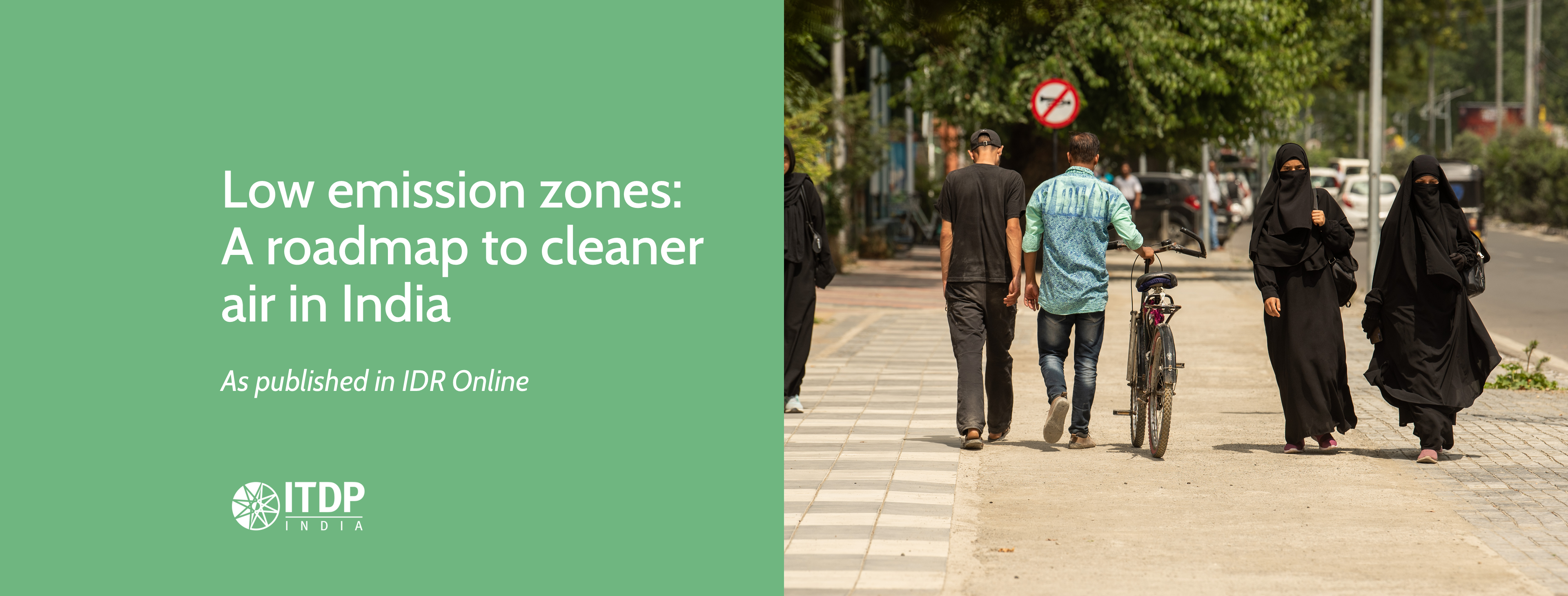
Low emission zones: A roadmap to cleaner air in India

26th March 2025 by admin

As published in IDR Online


Air pollution has escalated from an environmental issue into a full-blown health crisis, impacting people of all ages. Its far-reaching effects are evident in the rising cases of respiratory disorders, chronic illnesses, and even increased mortality.  

In North India, stubble burning, especially during the cooler months, is often considered to be the leading cause of air pollution. However, data indicates that year-round vehicular emissions are a more significant contributor to air pollution than stubble burning, construction, or firecrackers. According to the Emissions Inventory (2020), vehicles accounted for 46 percent of total PM2.5 emissions—harmful to human health—in Pune as well. Vehicles were also the largest source of harmful gaseous pollutants such as nitrogen oxides (73 percent) and carbon monoxide (66 percent). Between 2012 and 2019, PM2.5 emissions from transport in Pune surged by 91 percent, driven by rapid vehicle growth and the widespread use of highly polluting vehicle models.

Cleaner vehicle technology is not enough

To reduce emissions from vehicle tailpipes, the central government introduced Bharat Stage (BS)-VI standards in 2020 for internal combustion engine (ICE) vehicles, which run on fuels such as petrol, diesel, and CNG. These standards set limits on pollutants that vehicles are allowed to emit per kilometre. At the same time, schemes such as FAME India, along with various state and city initiatives, actively promote the adoption of electric vehicles (EVs).

However, ICE vehicles currently outnumber EVs on the road, nullifying any gains in emissions reductions from the latter. What’s more, there continue to be far too many pre BS–VI vehicles in circulation to make any real dent in vehicular pollution. A case in point is a 2023 study conducted by Institute for Transportation and Development Policy (ITDP) India and International Council on Clean Transportation (ICCT). The study found that approximately 70 percent of the vehicles plying in Pune and Pimpri-Chinchwad are pre-BS or BS-I to -IV, all of which are more polluting than BS-VI vehicles. Estimates show that one pre-BS car pollutes as much as 11 BS-VI cars, while one pre-BS truck pollutes as much as 14 BS-VI trucks.

To further complicate matters, a real-world vehicular emission study in Delhi and Gurugram revealed that BS-VI vehicles also exceed approved laboratory limits. Additionally, emission levels varied by vehicle type. For instance, BS-VI taxis and light goods vehicle fleets emitted 2.4 and 5 times more nitrogen oxides, respectively, compared to BS-VI cars used for personal purposes.

The long-standing mandate for Pollution Under Control (PUC) certification also falls short. The test is ineffective because it does not measure PM and nitrogen oxide emissions, testing only for carbon monoxide, hydrocarbons, and smoke. Furthermore, PUC assesses pollutants when the vehicle is stationary, not when it is in actual use. Hence, PUC certificates are not reliable indicators of a vehicle’s fitness with regard to its real-time driving emissions.

Low emission zones could be the answer

While encouraging cleaner vehicle technology is one part of the solution, there is also a need to simultaneously restrict the use of highly polluting vehicles.

Low emission zones (LEZs) are designated zones in a city where the use of polluting vehicles is restricted or discouraged. Such zoning aims to improve local air quality and health by reducing vehicle tailpipe emissions. Many cities—including London, Seoul, Paris, Lima, Brussels, and Beijing—have implemented LEZs. 

Cities typically make policies regarding which categories of polluting vehicles to restrict and where to impose these restrictions. Once an area is identified, signages and road markings are mounted to let drivers know that they are entering an LEZ. The rules are enforced by automatic number plate recognition (ANPR) cameras that read a vehicle’s number plate and identify whether it’s compliant or not. Cities like Paris mandate that every vehicle should have a sticker indicating their emission standard (Crit’Air sticker). In addition to these technologies, traditional traffic wardens visually identify violators as well.

But can LEZs be a silver bullet for vehicular pollution? Data from their implementation in London suggests they can in fact provide relief.

London’s LEZ—launched in 2008—now spans the Greater London Area, with approximately 1500 sq km demarcated as an Ultra Low Emission Zone (ULEZ). Its emissions standards are stringent and discourage the use of highly polluting or non-compliant vehicles by charging a heavy daily LEZ fee.

According to Transport for London’s six-month report published in July 2024, the ULEZ has helped reduce harmful roadside nitrogen dioxide (NO2) concentrations across the city. Over the years, the number of non-compliant vehicles driving within the LEZ has gone down as well. Now, a larger proportion of vehicles recorded in the LEZ are cleaner—96.2 percent, up from 39 percent in 2017. Further, a 2023 study by the University of Bath found that pollution reductions from the LEZ led to a 4.5 percent drop in long-term health problems and an 8 percent decline in respiratory issues.

At ITDP, we conducted a similar study in Pimpri-Chinchwad Municipal Corporation (PCMC) to determine the reduction in vehicular pollution as a result of restricting highly polluting vehicles in an LEZ and shifting users to the least polluting vehicles. Our study estimates that if the city government restricted pre-BS and BS-I to -IV vehicles in a designated LEZ and if vehicle users shifted to BS-VI vehicles instead, PM 2.5 emissions from vehicles could decrease by 80 percent by 2030.

Planning and implementing LEZs in India

LEZs are not new to India. Matheran, a holiday town in Maharashtra, restricts motor vehicle use to preserve clean air. Farther north, highly polluting vehicles are restricted around Taj Mahal to protect the monument from the corrosive effects of greenhouse gases. Delhi imposes an environment compensation (EC) charge on polluting trucks to discourage them from entering the city en route to neighbouring states, compelling them to take bypasses instead.

Over the last year and a half, ITDP India and ICCT have been supporting three cities in Maharashtra—Pimpri-Chinchwad, Pune, and Chhatrapati Sambhaji Nagar—in planning and implementing LEZs. The plan includes identifying highly polluting vehicle categories, defining LEZs, estimating benefits, and recommending complementary measures such as improving public transport connectivity and establishing enforcement systems.

In August 2024, the PCMC included LEZ in its Graded Response Action Plan (GRAP), a comprehensive strategy to reduce pollution across different sectors, including but not limited to vehicles. As per GRAP, the city will discourage the use of pre-BS and BS-I to -III private cars, two-wheelers, and light- and heavy-goods vehicles—which contribute approximately 90 percent of the total annual vehicular emissions—when the air quality falls to the moderate to poor category. The city will not ban such vehicles but will impose an Environment Protection Fee ranging from INR 100 to INR 750 daily for entry and movement inside the city.

LEZs must be accompanied with complementary measures like parking management, footpath, cycle tracks and public transport

However, translating policy into practice will require several key actions. Here are some of them:

1. Coordination between government departments

Implementation of LEZ measures will require the city government to set up robust enforcement mechanisms. For one, they will need to engage a variety of stakeholders, including the traffic police, Regional Transport Office (RTO) authorities, environmental agencies, and road departments, and establish seamless systems for coordination and communication. Additionally, the municipal corporation will need to deploy cost-effective and scalable IT-based solutions, such as ANPR cameras, to monitor and enforce rules, for which it will require dedicated funds.

But while city governments are responsible for designing and implementing LEZ frameworks, they often lack the legal authority, resources, or enforcement capacity needed for large-scale changes. State governments can provide the necessary legal frameworks, policy support, and regulatory backing to enable cities to effectively enforce these zones. It is equally important for the central government to be involved in drafting overarching policies, establishing national standards, and providing financial support to ensure that cities have the resources to implement the required infrastructure. The push towards transport electrification offers an example of such multi-tiered governance. The FAME-II policy, for instance, incentivises electric two- and three-wheelers (including e-rickshaws), commercial electric four-wheelers, and electric buses nationwide. At the state level, 21 Indian states have notified EV policies, with 15 offering direct incentives to EV buyers. These policies promote adoption through various consumer-facing incentives, such as purchase subsidies, exemptions from road tax and registration fees, reimbursements, and scrapping incentives.

2. Designing complementary infrastructure

Complementary infrastructure must be designed and funded to provide residents with viable, non-polluting alternatives to private vehicles. These include expanding public transport networks, widening or repaving footpaths, and installing charging stations for compliant vehicles. Barcelona’s Superblocks initiative is an example of an urban planning approach designed to reallocate public space from vehicular use. It reorganises traffic flow within a 3×3 grid of city blocks, prioritising pedestrians and community activities over vehicles. Within each superblock, traffic and non-residential parking are redirected to perimeter roads, significantly reducing vehicle movement inside. Streets within the superblocks are repurposed into pedestrian-centric spaces, with strict speed limits and an emphasis on accessibility. The reclaimed areas are enhanced with green spaces, bike lanes, playgrounds, and public seating, fostering a more vibrant and communal urban environment.

3. Garnering citizen support

Apprehensions about transitioning to cleaner vehicles are common in cities worldwide. For private EVs, the primary concern is the higher upfront cost, while for EV buses, resistance often stems from long procurement and waiting periods. Low-income groups and businesses are particularly impacted by the costs associated with this shift, which may lead to resistance against the policy. Delayed communication about the transition can exacerbate this issue. For instance, if potential buyers are unaware of upcoming restrictions on ICE vehicles, they might unknowingly invest a significant portion of their income in them, only to face policy changes later. This can create frustration and opposition to the transition.

Recognising this, many cities around the world announce such plans at least a year in advance, allowing residents and businesses to make informed choices. Paris, for example, supports small businesses in making the switch by offering financial incentives for cleaner alternatives. Brussels offers information on cleaner vehicle alternatives and financial assistance through its dedicated LEZ website. This website also features a mobility coach, a service that provides personalised advice on mobility options in the city.   

As India advances its efforts to combat air pollution and environmental degradation, LEZs can be a viable solution. By curbing vehicular emissions, these zones can play a crucial role in improving air quality, easing congestion, and reclaiming urban spaces for healthier, more liveable cities. However, their success depends on integrating them within a multi-pronged strategy that includes strengthening public transport, enhancing pedestrian infrastructure, and supporting a just transition for affected communities. LEZs can serve as a starting point for reimagining India’s cities—where clean air is a right and sustainable mobility the norm, with urban spaces that prioritise people over pollution.


Written by Parin Visariya, Deputy Manager at ITDP India

Filed Under: Low Emission Zones Tagged With: Air Pollution, ANPR, Delhi, Electric bus, electric mobility, GNSS, Health crisis, India, London, Low Emission Zones, Maharashtra, Pimpri chinchwad, Public Transport, Pune, Sustainable Transport, Sustainable Transport Policy, Vehicular Pollution

Are Indian Cities Budgeting Enough for Sustainable Transport? The Tale of Pune and Pimpri Chinchwad

26th February 2025 by admin

(Part 2 of Municipal Budget Analysis Series)


As cities across India gear up to draft their 2025-26 municipal budgets, the question looms: How well are they prioritising sustainable transport this time around? A good way to determine this is by analysing the municipal budget documents published yearly. This is an important exercise, after all, budgets don’t just outline the finances of the city but also reflect their vision. 

In this context, we delve into the findings from a municipal budget analysis of Pimpri Chinchwad Municipal Corporation (PCMC) and Pune Municipal Corporation (PMC). While our previous blog focused on PCMC, this one also highlights Pune, posing a key question: How do these twin conjoined cities which share mobility services like the metro, Pune Mahanagar Parivahan Mahamandal Ltd (PMPML) bus system, and interconnect streets, allocate municipal budget to sustainable transport initiatives? 

Budgetary Overview of Pune and Pimpri Chinchwad: Neighbouring Cities with Divergent Approaches 

To understand how Pune and PCMC prioritise sustainable transport, it is essential to consider their population, size, and 2024-25 budget allocations. 

Pune, a tier-1 city with 44 lakh Population (Projected for 2024) and 518 sq. km of area, contrasts with Pimpri Chinchwad, a tier-2 city with a population of 25 lakh (Projected for 2024) and one-third the size of Pune. The table below highlights their budget allocations. 

Key Highlights from Pune and Pimpri Chinchwad’s Budgets (2024-25) 

The team meticulously examined the city’s annual budgets for the past three years, scrutinising each line item related to transport and categorising them into ‘sustainable and non-sustainable modes’ of transport. Sustainable modes include projects that encourage walk, cycle, and use of public transport. Non-sustainable modes include items which encourage use of private motor vehicles and prioritise private vehicle movement over other sustainable modes. 

IndicesPunePimpri Chinchwad
Total Budget₹11,601 crore ₹8,676 crore 
Total Transport budget allocation₹2,320 crores (20% of total budget) ₹1,475 crore (17% of total budget) 
Total Sustainable transport budget:  ₹918 crores (~40% of the transport allocations)  ₹818 crores (~55% of the transport allocations) 
Allocations for non-motorised transport ₹351 crores (15% of the transport allocations) ₹459 crores (31% of the transport allocations) 
Allocations for Public transport (Buses and infra) ₹567 crore (24% of the transport allocations) ₹359 crore (24% of the transport allocations) 
2024-25 Budget Highlights

What were the key observations?

The analysis of budgetary allocations reveals contrasting approaches toward urban transport priorities, offering valuable lessons for other cities. 

1. Pune and Pimpri Chinchwad’s allocation for sustainable transport see slight differences  

In 2024-25, PMC and PCMC allocated significant portions of their municipal budgets to transport—₹2,320 crore (20% of total budget) for PMC and ₹1,475 crore (17% of total budget) for PCMC.  

Over the past three years, both cities have consistently spent about 16%-20% of their total budgets on transport initiatives. 

While Pune’s transport budget grew by 40% compared to last year and Pimpri Chinchwad’s by 31%, how they allocated these budgets tells a different story. 

Chart showing the annual trend of the percentage of transport budget allocated under the total municipal budget.

While PMC allocated a higher absolute amount for sustainable transport (₹918 crore vs. ₹818 crore for PCMC), a closer look at the percentage reflects a different reality. Sustainable transport makes up only 40% of Pune’s transport budget, whereas Pimpri Chinchwad allocated 55.5% of its transport budget to sustainable initiatives. 

Chart showing the annual trend of the percentage of transport budget allocated to ‘sustainable mobility’ initiatives by Pune and Pimpri Chinchwad

2. The curious case of missing allocations for cycle tracks in Pune 

The budgets for Non-Motorised Transport (NMT) infrastructure, which includes building footpaths and cycle tracks, were a mixed bag for Pune in 2024.  

The city allocated ₹351 crore for NMT (15% of its overall transport budget). However, what is concerning is that there is no dedicated fund allocated for cycle tracks.  


This is surprising, given that since 2018, Pune has had a dedicated budgetary allocation for building cycle tracks in alignment with the Pune Bicycle Plan (2017), which set an ambitious goal of increasing cycling’s modal share from 3% in 2017 to 25% by 2031. At one stage, PMC allocated ₹75 crore in 2018-19 to gradually declining it to ₹3.3 crore 2023-24. However, this year, there was no dedicated fund towards this. Pune has projects like ‘Pune Streets Program (PSP) which gets dedicated funding every year through which city can develop footpaths and cycle tracks.  

Glimpses of Pune’s vibrant cycling culture. With no sustained and dedicated investment, this community is at risk

In comparison, Pune’s transport budget in 2024 saw a sizeable amount to build more flyovers! ₹93.5 crore is allocated for grade separators, including flyovers, in Pune budget. This marks a concerning trend as flyover are known to only offer temporary relief from congestion. 

On the other hand, Pimpri Chinchwad has adopted a more balanced approach, allocating 31% of its overall transport budget for NMT. They allocated ₹459.4 crore in 2024-25 for NMT. This accounts for 31.1% of Pimpri Chinchwad’s overall transport budget—double Pune’s share for NMT.  

PCMC has projects like the ‘Urban Streetscapes’ and the ‘Harit Setu’ program which gets dedicated funding every year through which city develops footpaths and cycle tracks. 

In terms of funds for flyover, PCMC has dedicated ₹27.7 crore to flyovers in 2024-25 budgets, which as mentioned above only offers temporary relief from congestion. 

3. Both cities commit VGF for PMPML, but not so committed to allocating for new buses 

In the 2024-25 municipal budget, Pune allocated ₹567 crore, (24% of the transport allocations) towards PMPML bus services while Pimpri Chinchwad allocated ₹358.6 crore (24.3% of transport allocations).  This is the overall allocations for public transport; however, a closer look shows that the majority of this went towards Viability Gap Funding (VGF). 

VGF is a specific component given by both cities to PMPML to operate buses and cover PMPML’s operational costs. As agreed by the cities, this VGF is distributed in specific proportions, with PMC covering 60% of the amount sought by PMPML, and PCMC contributing the remaining 40%. 

PMPMPL needs funds beyond VGF to procure new buses

In this context, Pune allocated ₹536.43 crore of the ₹567 crore in 2024-25 as VGF for PMPML. Pimpri Chinchwad provided ₹290.4 crore out of the ₹358.6 crore in 2024-25 as VGF for PMPML. These budget allocations are to keep the service afloat for day-to-day operations.  

However, the budget allocation for new buses and improvement of the Rainbow Bus Rapid Transport (BRT) infrastructure, while critical, is negligible.   

PMC set aside just ₹58 lakh while PCMC allocated ₹4.27 crore towards the BRT service improvement and infrastructure.  

4. Both cities dip into central funds  

Beyond municipal budgets, central and state schemes significantly shape urban mobility. 

Both cities maintain separate lists for central and state funds, such as NCAP, AMRUT, and JNNURM. Pune allocated ₹103 crore under NCAP for sustainable mobility, including ₹38 crore for NMT-friendly streets. Pimpri Chinchwad on the other hand, allocated ₹77 crore under NCAP for sustainable mobility, with ₹23 crore for NMT-friendly streets. 

Under the 15th finance commission, both the cities have tapped into national funds. Through these funds, Pune allocated ₹25 crore for last-mile metro connectivity, ₹30 crore for e-bus procurement, and ₹10 crore for six e-bus depots. Pimpri Chinchwad, allocated ₹42 crore for last-mile metro connectivity and ₹12 crore for EV charging stations.  

PCMC took a more integrated budgeting approach for transport related projects, allocating ₹262.5 crore through the Urban Transport Fund (UTF). Of this, 48% was dedicated for NMT and public transport, with the rest for carriageway, and bridges etc. 

With its newly formed Urban Mobility Department, PCMC plans to increase UTF allocations for sustainable transport in 2025-26, reflecting a stronger on sustainable mobility and integration. PMC has had no such dedicated UTF budgets. 

 In a Nutshell

Overall, it is evident that Pune, despite a larger allocation for transport than in the previous years in terms of absolute numbers, was not successful in improving their percentage share for sustainable transport.  

PCMC is steadily increasing its investment in sustainable transport, a positive trend that must continue to meet its NMT and public transport goals. Meanwhile, Pune must significantly boost its allocations to reverse its declining trajectory and stay on track with its mobility vision. 

Six key lessons for other cities when developing ‘Annual Municipal Transport Budget’ documents and strategies 

The analysis of Pune and Pimpri Chinchwad’s transport budgets reveals critical best practices that other cities can adopt to create effective, transparent, and sustainable urban mobility strategies. Here are six actionable takeaways: 

  1. Uniform format and transparency:  Municipal budgets should follow a consistent, detailed format to track trends and enable comparative analysis. Both Pune and PCMC use uniform budget templates annually, making it easier to track allocations. They also stand out as cities that publish budget documents online each year in local/regional languages. 
  2. Follow a detailed template consistently: Cities should use detailed templates for project-wise budget allocations instead of lump sums. This improves transparency by listing total project costs, yearly allocations, and expenditures, ensuring accountability. Both Pune and Pimpri Chinchwad follow project-based budgeting. Pune traditionally allocates funds under initiatives like road safety, pedestrian policy, and bicycle tracks, while Pimpri Chinchwad focuses on programmes like Harit Setu, Urban Streetscapes, and the Parking Policy.  
  3. Align transport budgets with city goals: Municipal budgets allocations should reflect/align with the transport goals identified in the city’s plans and policies. Regular sustainable transport budget analysis help identify shortcomings, while providing opportunities for course corrections. 
  4. Ensure a diverse revenue streams: Cities should diversify revenue sources, including land value capture, revenue from parking management, international sources, and even municipal bonds, if possible, to reduce reliance on state or central allocations. This ensures consistent funding for transport projects boosting the municipal allocations. Both cities are looking at Municipal bonds for funding mobility projects. PCMC has also participated in national and international competitions for fetching additional funding.  
  5. Create dedicated budget heads for priority projects: Cities should establish dedicated budget heads for priority sustainable transport projects, like implementing footpaths, junction improvement, bus augmentation, bus infra upgradation, etc. Part of the allocation should be for implementation of policies and plans, research, capacity development of staff, road safety initiatives, etc. Each project should have a clear line item in the budget. This approach ensures targeted and continuous funding and ensures accountability. 

The budget analysis of Pune and Pimpri Chinchwad tells a clear story that while these twin cities share mobility networks, their financial commitments to sustainable transport differ significantly. This will eventually reflect in the way they set out to achieve their sustainable transport goals. 
 
As cities across India prepare their 2025-26 municipal budgets, ensuring a consistent and transparent approach to transport funding will be key to creating accessible, efficient, and sustainable urban mobility. After all, where cities put their money today will shape how people move tomorrow. 

Written by Pranjal Kulkarni, Programme Manager- Healthy Streets and Compact Cities, Rutuja Nivate, Associate, Urban Development, and Siddhartha Godbole, Senior Associate- Urban Development

Edited by Donita Jose, Senior Associate Communications

Filed Under: Low Emission Zones, sustainable-transport-magazine, Transportation budget Tagged With: Electric bus, electric mobility, India, Maharashtra, Municipal Budget, Parking, Pimpri chinchwad, Public Transport, Pune, Sustainable Transport, Sustainable Transport Policy

A Marathon, Not a Sprint — Lessons from India’s Walking and Cycling Challenges

16th January 2025 by admin

As published in the Sustainable Transport Magazine


As we close the chapter on two of India’s landmark mobility initiatives, the India Cycles4Change (C4C) and Streets4People Challenges (S4P), there is much to celebrate from this transformative four-year journey. Four years is also the time it takes to prepare for the Olympics, and just as the world has witnessed the spirit of the 2024 Paris Summer Games, these efforts share many things in common. Just like Olympic athletes need consistent training and resources to shine on the global stage, Indian cities received continuous support and guidance to shine throughout these Challenges. With help from national and local experts, they built a network of partners, engaged with their community, and strengthened their capacity through open dialogue and collaboration, ensuring they had everything they needed to create safer and more accessible streets for all. 

In 2020, India’s Smart Cities Mission, Ministry of Housing and Urban Affairs (MoHUA), and ITDP India collaboratively launched the India Cyles4Change and Streets4People Challenges with a vision to transform Indian cities with improved walking and cycling infrastructure. Many of India’s streets have become increasingly dangerous for the most vulnerable, with pedestrians accounting for 20% of road fatalities in 2022, according to the Ministry of Road Transport and Highways. This is a staggering 32,800 lives lost. Also, India’s air pollution and quality ranks among the worst in the world. To combat this, we need more people to choose walking and cycling over private vehicles where possible. Cities must create a safer and more conducive environment for both new and existing pedestrians and cyclists for this shift to happen.  

However, at the onset of the two Challenges, the team began to realize that expecting quick on-ground transformation was fairly ambitious. While 117 cities signed up for the Challenges, they were all at different points in their journeys, with respect to their understanding of sustainable mobility, resources, infrastructure, geography, and institutional ecosystems. Even though this was a friendly and healthy competition, fairness would be compromised if the participants started from different points. Thus, the team went back to the drawing board and changed the rules of the game itself. It was no longer just about the scale of on-the-ground transformations; equally important would be promoting the dialogue around walking and cycling, improving community engagement, and building a stronger foundation for capacity building and institutional reform. Over the next few years, these programs became a marathon, rather than a sprint. 

The Streets4People Challenge reimagined city streets as places for civic engagement. Image: Smart Cities Mission / ITDP India


The government and ITDP India began by channeling the focus on three aspects that ensured our efforts were sustained throughout the four years. One, by creating an ecosystem of champions from city leaders to local communities for support; two, by encouraging cities to engage with citizens to get their buy-in at the onset; and three, by building their technical capacities at regular intervals in the most innovative way possible.  The true success of these Challenges came from lasting lessons that have set the cities on a course for change for years to come.

At the beginning of the Challenges, cities were required to pilot interventions locally and gather community feedback before making them permanent interventions. Many successfully implemented changes using tactical urbanism to test designs that could be adjusted based on how people engaged with spaces. For instance, the city of Kohima transformed an old parking lot into a vibrant community space for pedestrians and cyclists, featuring food vendors, pop-up seating, colorful artwork, and new landscaping. They also programmed street carnivals and engagement activities to activate the community within the space. Some cities that lacked such expertise connected with support from partners such as civil society organizations, design experts, resident groups, and cycling advocates. The success of these partnerships underscored the importance of creating local communities of champions as knowledgeable stakeholders who could guide cities through the design and implementation process, ensuring that efforts were both sustainable and impactful. 


While this was happening at the city-level, a burgeoning ecosystem was also taking shape at the national level with these Challenges. The commitment to promoting active mobility had full support from the national Ministry, driven by strong leadership that believed in the cause. It became evident that many city leaders were inspired to become champions after seeing the dedication of the Ministry. The national ecosystem was further strengthened by the collaboration with organizations  like ITDP India, which played a crucial role in providing technical expertise. This guaranteed that, while cities had the financial and national support to implement the Challenges, they could also benefit from strong technical guidance to ensure their concerns were addressed throughout the process.  

Of course, no best practice can be formed without citizen and  public engagement. Cities initially faced challenges in motivating their people, shifting perceptions, and breaking stereotypes  
around cycling and walking. Many residents did not view these as practical alternatives to personal vehicles and resistance to streetscape changes made progress challenging. However, as the  
programs progressed, engaging communities in decision-making was crucial to fostering a sense of ownership, leading to greater acceptance and behavior change. Take the city of Davanagere,  
for example. They ran a creative campaign that made cycling ‘cool’ again with themed merchandise, bike rallies, and citywide promotions. Local residents soon embraced cycling en masse,  
rallying behind the vision for safer, more sustainable mobility. That is the power of bringing people along for the ride.

The Cycles4Change Challenge encouraged cities to improve safe, connected cycling infrastructure. Image: Smart Cities Mission / ITDP India

Each city’s own growth remained at heart of this work, which is why building capacity was crucial for the success of these Challenges. Having the right support to build expertise and skillsets for cities was part of a winning strategy. Throughout the Challenges, ITDP India helped host 18 sessions for cities, including national Healthy Streets and Public Spaces workshops in cities like Bengaluru, Chandigarh, and Pimpri Chinchwad, and interactive design clinics for city leaders to receive input from experts. Over 85 toolkits and technical resources on planning, budgeting, and infrastructure were developed and disseminated during these workshops.

To make capacity building even more engaging, ITDP India also introduced an innovative game during these workshops. This fun and interactive approach helped city leaders learn how to  
develop a Healthy Streets Plan, map out a multi-year action plan, and identify key interventions in three crucial areas: action, foundation, and communication. This ‘gamification’ strategy  
helped the leaders immerse themselves in a hands-on learning experience, moving beyond traditional presentations to explore the complexities of sustainable mobility. 

By January 2024, 15 cities emerged as leaders, with many others making great strides in changing their streets. Across 33 cities, over 350 kilometers of improved footpaths and more than 220 kilometers of cycle tracks were developed, while 48 cities launched projects to revamp over 1,400 kilometers of streets. Plus, 15 cities adopted Healthy Streets Policies, 18 set up dedicated Healthy Streets groups, and 17 developed their three-year action plans. To top it off, 33 cities formed Apex Committees to keep the momentum going with future collaboration.


As we close the transformative chapter of the Cycles4Change and Streets4People Challenges, these initiatives have set the stage for long-term change nationwide. Success was not merely about achieving quick wins; it was about laying the groundwork for resilience by mainstreaming dialogues, building capacity, and fostering an ecosystem of walking and cycling champions.

Like coaches preparing a team for victory, the Ministry and ITDP India helped lay a solid foundation for scaling walking and cycling options across India. Now, it is important for the national government to capitalize on this momentum by allocating more budgets and strengthening policies and institutional reforms in favor of safe, equitable streets for everyone. Let the next  Challenge begin!  

Written by Kashmir Medhora Dubhash, Senior Programme Manager – Communications, Partnerships and Development

Technical inputs Smritika Srinivasan, Senior Associate – Urban Development

Filed Under: sustainable-transport-magazine, Walking and cycling Tagged With: Complete Streets, Cycle4Change, Healthy Streets, India, Maharashtra, Parking, Pimpri chinchwad, Public Transport, Pune, Smart Cities Mission, Streets4People, Walking and Cycling

10 Impactful Solutions to Improve India’s Air Quality

10th December 2024 by admin


Air pollution in India has reached a tipping point, threatening the health and well-being of millions. Amid this growing crisis, one promising solution is the implementation of Low Emission Zones (LEZs)—designated areas where polluting vehicles are restricted to curb emissions and improve air quality. To help cities across India tackle this issue, ITDP India recently launched Low Emission Zone Basics, a comprehensive guide for creating cleaner, healthier urban environments. 

At the launch, experts from global organisations shared crucial insights on how LEZs can play a pivotal role in addressing air pollution, while also offering policy recommendations to guide India’s path to cleaner air. From improving data collection to enhancing public transport and promoting localised climate action, these strategies provide a roadmap for urgent and effective change. Read on for key takeaways from the experts who are shaping the future of India’s air quality. 

The experts include, Shashi Verma, Chief Technology Officer, Transport for London (TfL); Dr. Anju Goel, Associate Director at The Energy and Resources Institute (TERI); Parin Visariya, Deputy Manager at ITDP India; Dr. Sandra Wappelhorst, Senior Researcher at The International Council on Clean Transportation (ICCT), Berlin;  Sree Kumar Kumaraswamy, Program Director at World Resources Institute (WRI); and Dr. Vivek Vaidyanathan, Program Manager at Artha Global. 

1. Better research on sources of air pollution

Central government must invest in better collection and dissemination of data and research on the sources of pollution. To date, the public debate around pollution in India is clouded in fog with some suggesting it is because of Diwali and some suggesting is because of crop burning, which is fundamentally not true. Air pollution in Gangetic plains is far more complex and getting better evidence is something central government can work on – Shashi Verma, Chief Technology Officer, Transport for London (TfL)    

2. Need for multiple interventions

London’s air quality success stems from a series of cumulative interventions since the 1950s, starting with banning coal burning, introducing clean diesel programmes, and expanding LEZs. A major contributor to improvement was increasing the mode share of sustainable transport, which reduced overall vehicle numbers. The broader lesson is to have a comprehensive approach in addressing multiple sources of pollution. – Shashi Verma, Chief Technology Officer, Transport for London (TfL) 

3. State government must approve LEZs 

Pimpri Chinchwad, in Maharashtra has decided to implement an Environmental Protection Charge ranging from ₹100-750, for polluting vehicles entering the LEZs. But the enforcement of this requires collaboration with the Road Transport Officials (RTOs) and traffic departments. Currently, there is no provision within the transport department to address such violations, making the need for an enforcement mechanism essential. State-level approvals and notifications are also necessary to formally designate the area as a LEZ. State governments must play a supportive role by bringing all stakeholders together to develop a clear, actionable plan. – Parin Visariya, Deputy Manager at ITDP India 

4. Improve public transport

Public transport connectivity in most cities remains inadequate and requires significant upgrades. State support is crucial to ensure there is an increase in the number of buses and improvement in the overall network. – Parin Visariya, Deputy Manager at ITDP India

5. Package LEZs for health

One way to get faster acceptance of concepts like LEZs is to make the stakeholders focus on how it will improve health. Talking about its benefits in sensitive areas in terms of schools, places of worship, hospitals, works well in convincing city authorities to take this up. – Dr. Vivek Vaidyanathan, Program Manager at Artha Global 

6. Focus on funding clean air in rural areas

Currently the National Clean Air Programme funds go only to urban local bodies, where the concerns are more about road dust, vehicular emissions etc. But when it comes to rural areas, these funds are not applicable. Here the sources of pollution are also different like biomass burning. This is when state governments need to pitch in. Having only NCAP as a funding source won’t solve the problem. We need various other state level schemes.  – Dr. Anju Goel, Associate Director at The Energy and Resources Institute (TERI) 

7. Budget for climate at municipality levels

Cities must explore ways to tap into their existing municipal budget to start climate works. If all departments commit some amount to climate, it can be a starting point with no need to look outside for funds. For instance, in most municipalities, the roads budget is the highest- so it can be leveraged to implement action to create clean air. – Sree Kumar Kumaraswamy, Program Director at World Resources Institute (WRI) 

8. Develop state-level schemes

States must come up with innovative mechanisms like the Majhi Vasundhara initiative in Maharashtra where the state has decentralised climate action. Now be it a village or a city, through their own means, they can take up small ticket projects that work towards climate action. This kind of model of sourcing innovation from the ground up is an excellent example and state can play a facilitating role to enable thinking innovatively. – Sree Kumar Kumaraswamy, Program Director at World Resources Institute (WRI) 

9. Focus on creating a good narrative

Create a phased and gradual LEZ plan with clear timelines to allow citizens and businesses to have time to adapt. Offer financial assistance to low-income groups and small businesses to transition to compliant vehicles. Develop mobility programs like air bonuses to encourage alternatives to car ownership. Speak to all stakeholders and communicate the programme. – Dr. Sandra Wappelhorst, Senior Researcher at The International Council on Clean Transportation (ICCT), Berlin 

10. Start with CPCBs and non-attainment cities

When working with state governments, the Central Pollution Control Board is a good entry point, wherein they can enact some of the state-wide regulations and laws that’s applicable to all non-attainment cities. – Dr. Vivek Vaidyanathan, Program Manager at Artha Global

Low Emission Zone Basics


Written by Donita Jose, Senior Associate, Communications and Development, ITDP India

Filed Under: Low Emission Zones Tagged With: Air Pollution, ANPR, Delhi, Electric bus, electric mobility, GNSS, Health crisis, India, London, Low Emission Zones, Maharashtra, Pimpri chinchwad, Public Transport, Pune, Sustainable Transport, Sustainable Transport Policy, Vehicular Pollution

Are Indian Cities Budgeting Enough for Sustainable Transport? A Case from Pimpri Chinchwad

20th November 2024 by admin

(Part 1 of Municipal Budget Analysis Series)


Annual municipal budgets shape how the city’s resources- the taxpayers’ money- are allocated to shape the city and in turn serve its residents. However, the question arises: do the city’s annual budgets reflect investments in mobility for cleaner air and congestion-free streets, which have been challenging for most cities? Such budget allocations are even more critical for rapidly urbanising Indian cities. 

Pimpri Chinchwad is one of India’s fastest-growing tier-2 cities. Through its ambitious policies, plans, and projects, Pimpri Chinchwad has been actively striving to build a robust sustainable urban mobility system in the city.  Pimpri Chinchwad Municipal Corporation’s (PCMC) bold policies, including the Non-Motorised Transport Policy (2021) and Pune Metropolitan Region’s Comprehensive Mobility Plan (2018), aim for 90% of trips to be made by walking, cycling, or public transport by 2036. PCMC also aims to reduce private vehicle trips by 18%, focusing on a fair distribution of road space between all users and a shift towards sustainable urban transport modes such as walking, cycling, and public transport. However, as per Parivahan data, with nearly 90 vehicles per 100 residents, congestion, road safety, and air quality remain major challenges.  

PCMC is well aware of this alarming figure and is making every effort to address it. With the further expansions of the existing 54 km of Bus Rapid Transit and the 7 km of Metro, along with 16 km of suburban rail, and more than 100+ km of redesigned healthy streets, the city is reshaping how people move.  

While in the last decade, the city has made strides with its sustainable transport initiatives, how can we ensure it remains committed to creating safer streets, reducing congestion and improving air quality? 

One key indicator of the city’s commitment to its sustainable transport goals is how much allocation of the municipal funds goes to various transport modes, especially the sustainable ones – walking, cycling, and public transport.  

PCMC collaborated with ITDP India to analyse the city’s annual budget allocations from 2022-23 to 2024-25 (across a period of three years) focusing on mobility projects in the city. In June 2024, ITDP launched the ‘PCMC Municipal Budget Analysis Report’ capturing the insights from this research project. 


Why was the study conducted?

The study was conducted to gain a nuanced understanding of historical budget allocation trends, assess current allocation patterns, and identify gaps and opportunities for future provisions towards urban mobility. It aimed to establish a detailed report of funding requirements through projections and provide informed recommendations to enhance the upcoming annual mobility budget allocations. Additionally, this study was undertaken in response to the lack of such detailed case studies in India, highlighting the need for more structured approaches to urban mobility budgeting and planning. 

How did we do it?

The team meticulously examined the city’s annual budgets for the past three years, scrutinising each line item related to transport and categorising them into ‘sustainable and non-sustainable modes’ of transport. Sustainable modes include projects that encourage walk, cycle, and use of public transport. Non-sustainable modes include items which encourage use of private motor vehicles and prioritise private vehicle movement over other sustainable modes. 

What were the key observations?

1. Transport allocations inching towards its sustainable transport goals 

With a total municipal budget of ₹8,676 crore, PCMC has one of the highest per capita budgets allocated in the state. In 2024-25, 17% (₹1475.4 crore) of the annual budget was allocated to transport– an increase in proportion to the overall increase in municipal budget as compared to the previous year. Additionally, over half of the current transport budget is now allocated to sustainable transport infrastructure, up from 48% (₹540 crore) to 56% (₹818 crore) as compared to the previous year. 

Graph showing an upward trend in PCMC’s annual transport allocations, along with the sustainable and non-sustainable allocation split 

2. Significant increase in allocation towards walking-cycling infrastructure 

The non-motorised transport (NMT) budget allocation of ₹439.7 crore accounts for more than half of the sustainable transport budget and one-third of the entire transport budget! As compared to the previous years, the city has more than doubled its allocation towards NMT from ₹217.9 crore in 2023-24 to ₹439.7 crore in 2024-25 which is a move in right direction. This shift is mainly due to the allocations for the ambitious ‘Harit Setu’ project that aims to make PCMC a 15-minute walking-cycling neighbourhood city and ‘Urban Streetscapes Programme’ (USP). In addition, this also includes allocations for initiatives like cycle sharing systems, parking management, and maintenance of infrastructure. 

Sankey graph showing the detailed transport allocations for the year 2024-25

However, PCMC needs to allocate a similar amount consistently every year towards creation of footpaths and cycle tracks to achieve the goal of 90% of all trips by sustainable modes by 2036. This budget will support the transformation of 25 km of major streets and 100 km of minor streets each year. Only by maintaining this aggressive pace, can PCMC systematically transform its streets over time and move closer to achieving the NMT Policy’s targets. 

3. Need for more investment in public transport 

While there have been significant efforts to improve walking and cycling, there is a gap in funding for more public buses. There is still a need to make buses more accessible to everyone. The city funds its public bus system by providing Viability Gap Funding (VGF) to the city’s transport undertaking – Pune Mahanagar Parivahan Mahamandal Ltd (PMPML). However, the city’s budget allocation for buses has seen a slower increase, rising from ₹231 crore in 2022-23 to ₹359 crore in 2024-25 for buses over the four years. According to PMPML’s Vision 2027, the city currently has around 26 buses per lakh population, which is half of the national guideline of 60 buses per lakh population and an exponential increase is needed to meet these goals. In addition to the operational expenditures, PCMC needs to allocate an estimated ₹730 crore annually to achieve target bus fleet of 2850 size (as per the recommended MoHUA standards) by 2030. 

Comparative chart showing the non-sustainable and public transport allocation trends 

4. Car-centric investments still dominate the budget 

As one of the fastest-growing cities, Pimpri Chinchwad has also prioritised the development of new streets to ensure connections to the new villages. As a result, the private motor-vehicle-centric road expenditure is reasonably high. It is critical for such cities to ensure this new development is equitable and caters to the needs of pedestrians, cyclists, and public transport. The allocation of budget for car-centric infrastructure, such as flyovers and multi-level car parks, is consistently high. At ₹657 crore, PCMC is allocating twice as much for non-sustainable transport than that for public transport. Surprisingly, some programs, like Sustainable Urban Transport Projects (SUTP) and Urban Transport Funds (UTF), earmarked for sustainable development have budgetary provisions for car-centric projects. A 100% of the ₹4.5 crore under SUTP and 51.6% of the ₹262.5 crore under UTF are allocated towards non-sustainable transport projects like carriageway and flyover development. 

In a Nutshell

The substantial doubling of funding for walking and cycling projects highlights PCMC’s commitment to its NMT Policy goals. However, public transport remains underfunded with a visible shortfall of buses and a dire need for improved quality of service in the city. On the contrary, car-centric projects continue to receive disproportionately high funding. To achieve its goals, PCMC should not only increase funding for sustainable transport initiatives but also simultaneously reduce the allocations for high-value car-centric infrastructure. This can be achieved through reallocation of existing budgets towards sustainable transport projects. 

The study also provides recommendations for a sustainable transport-focused budget, exploring innovative revenue sources like parking management, municipal bonds, national and international grants. It also emphasises the need to consistently allocate budgets for walking, cycling, and public transport projects to help PCMC maintain its status as a leader in sustainable transport in India.  

Since presenting the findings at the Smart Cities Mission’s National Conference in January 2024, the team has also been focusing on helping cities with securing additional funding through this data-driven approach. In the next blog in the series, we’ll take a deep dive into the process of the budget analysis including methodology, limitations, and the challenges faced while conducting the study. Stay tuned! 


Written by Donita Jose, Senior Associate Communications

Edited and technical inputs by Rutuja Nivate, Associate- Urban Development and Pranjal Kulkarni, Programme Manager – Healthy Streets and Compact Cities

Filed Under: Low Emission Zones, sustainable-transport-magazine, Transportation budget Tagged With: Electric bus, electric mobility, India, Maharashtra, Municipal Budget, Parking, Pimpri chinchwad, Public Transport, Pune, Sustainable Transport, Sustainable Transport Policy

Three Things Indian Cities Need to do Now to Start the Fight Against Vehicular Pollution 

4th November 2024 by admin


“Winter is coming”—a phrase made famous by the sitcom series Game of Thrones—has found an eerie resonance in India. Much like how the people of Winterfell dreaded the arrival of winter and the mythical evil creatures- the White Walkers, in India, it is not a creature, but the polluted air itself, that is dreaded.  

Though it’s barely November, a thick layer of pollutants is already blanketing the skies, and all eyes are searching for the culprits. Is it construction waste, crackers, or crop burning? However, one source, which remains largely overlooked, and often slides through the cracks, while continuing to remain the biggest challenge- is vehicular pollution. A recent study by the Indian Institute of Tropical Meteorology confirms this. Conducted in the month of October 2024, the study revealed that stubble burning contributed only 1-2% of Delhi’s total air pollution in the month, while vehicular emissions accounted for a significant 11.2% – 14.2%. This makes vehicle emissions the single biggest identifiable, yet silent contributor to poor air quality, which affects the Indian cities not just in winter but year-round—making it the most urgent problem to address. 

Infact, studies being released year after year all indicate how rapidly the situation is deteriorating. The latest report reiterating this, is the Greenpeace report, which spotlights the alarming situation in South Indian cities specifically, which conventionally were believed to have cleaner air. The data from this report suggests the PM2.5 level in these cities is also no better for living standards, with a few like Hyderabad, Chennai, and Visakhapatnam, seeing levels up to 9- 10 times higher than WHO standard. As explained above, a significant part of these rising pollution levels is contributed by the growing population of vehicles.  

While the sustainable transport sector has long advocated for walking, cycling, public transport, and clean vehicle technology as solutions, it is clear that combating vehicular pollution requires a multifaceted approach beyond that. This blog outlines three key Mantras (strategies) that cities can adopt right now to tackle this growing menace. Some of these have already been implemented/ in the process of implementation in our lighthouse city, Pimpri Chinchwad, which stands as a good example for many other growing Indian cities. 

1. Shift to sustainable modes such as walking, cycling, and public transport  

First, cities should focus on creating not just isolated stretches but comprehensive networks of footpaths and cycle tracks. A well-connected network makes sustainable transport options more convenient and accessible, encouraging people to shift to these modes.  

However, providing just infrastructure may not be enough in most cases. Cities must invest in raising awareness through campaigns to nudge behavior change. Policies and legislative reforms are also crucial to embedding these practices into the city’s fabric. 

What’s a good model to emulate? Many global cities, such as Singapore, have initiated the concept of 15-minute cities. Some Indian Cities have had the chance to adopt this concept, leveraging existing initiatives like the Harit Setu project in Pimpri Chinchwad, which aims to enhance walking and cycling infrastructure in the city. Here, the plan is to make a localised network of connected footpaths and cycling tracks within smaller neighbourhoods, across the city so that people can simply opt to walk or cycle for short distances. Through such interventions, they also get sustainable options for last- mile connectivity. 

A glimpse of Linear Garden street, one of the ideal streets in PCMC which prioritises pedestrians and cyclists

However, while walking and cycling provide a sustainable alternative for short trips, they alone will not reduce congestion or pollution. For longer trips, more and better buses which connect the many networks of roads are the need of the hour to alleviate pollution and congestion. Moreover, improving bus services, including their frequency, reliability, and coverage, is crucial. Buses should seamlessly integrate with other transport modes, such as metro systems, footpaths, and cycle tracks, creating a comprehensive and efficient transport network. This interconnectedness enables commuters to make longer journeys more conveniently, thus making public transport a more attractive option. 

While these suggestions might shift a chunk of road users to sustainable modes, there will still be a section who would opt to use personal/private vehicles for travel because of its convenience. To address the emission concerns for that segment, incentivising cleaner vehicles will be an option.  

2. Incentivise people to use cleaner vehicles

Alongside promoting sustainable modes of transport, cities need to encourage the use of cleaner vehicles. This can be done in three ways: transitioning to cleaner technologies, scrapping older polluting vehicles, and building robust electric vehicle (EV) infrastructure. 

India has already taken a step in this direction by adopting Bharat Stage-VI (BS-VI) emission standards, which significantly reduce emissions from new vehicles. However, cities can push this further by promoting electric vehicles (EVs). Local governments should implement strong scrappage policies that incentivise owners of older, polluting vehicles to retire and scrap them in exchange for financial benefits or rebates on EVs.  

Cities also need to upscale their EV infrastructure, particularly by setting up widespread charging stations. A comprehensive EV Readiness Plan can guide cities in developing this infrastructure and ensuring that the transition to EVs is smooth and well-supported. 

For example, Pimpri Chinchwad’s Electric Vehicle Readiness Plan 2023 outlines some of these, by setting a goal of having 30% of the new vehicle registrations in city shift to EV by 2026.  They are doing so by establishing 100 EV charging stations and offering incentives for e-auto drivers. Property tax rebates are also being offered to those setting up charging point in their properties. Furthermore, the PCMC’s and Pune’s shared bus service, Pune Mahanagar Parivahan Mahamandal Ltd (PMPML), already operates 473 e-buses—India’s third-largest fleet—and is continuing to expand its fleet. These efforts – both on the front improved vehicle technology and on the front of emission reduction through improved public transport, not only reduce emissions but also set the stage for a future where EVs become the primary mode of motorised transport. 

Cities infact can go a step further, to effectively promote the use of cleaner vehicles. They can go for a dual approach of simultaneously making it more challenging to rely on personal vehicles.  

An electric bus from PMPML fleet

3. Discourage the use of personal vehicles through pricing parking and LEZs 

Cities must make it harder for people to rely on private vehicles, especially older, polluting models. Two effective ways to achieve this are by pricing parking and establishing Low Emission Zones (LEZs). 

Proper parking management can reduce the number of vehicles on the road by making it expensive to park in public spaces. When parking fees are levied, people think twice before using their cars, potentially avoiding the trip, opting for shorter trips, using public transport or finding other alternative solutions instead. This approach not only discourages unnecessary vehicle use but also frees up critical street space for creating vibrant public spaces on street. When authorised designated spots are demarcated by the city on the streets, it further reduces the time and fuel wasted in searching for a parking spot.  

Effective parking management can deter vehicle use, while LEZs take it a step further by restricting the most polluting vehicles from entering key areas. Together, they provide a strong mechanism to reduce vehicular emissions. 

In an LEZ, only vehicles with low or zero emissions—such as electric vehicles or those that meet the recommended emission standards (BS-VI)—are allowed to enter. LEZs can be city-wide or focused on strategically selected areas, making them an effective tool for cutting emissions in densely populated regions. 

For instance, in cities like London there has been a drastic reduction. As per the Mayor’s report, London’s Ultra Low Emission Zone (ULEZ), launched in 2019, has led to a 44% reduction in nitrogen dioxide levels and a roughly 30% decrease in traffic in central areas, alongside a 21% increase in cycling. 

In India, a study by ITDP India and ICCT in Pimpri Chinchwad found that restricting pre-BS-VI vehicles in a designated LEZ could reduce PM 2.5 emissions by up to 91% within a year (if all the pre-BS-VI users switch to EVs). Without such measures, pollution levels will decrease by only 50% in the next five years, under current practices (which involves the expected business as usual gradual natural transition to BS-VI). 

Designated parking spaces created on a street in PCMC

While these three Mantras provide a holistic approach to combat vehicular emissions, acknowledging the issue is the first step.  We urge cities and policymakers not to let air pollution caused by vehicles fade into the background or be treated as a seasonal issue. Addressing vehicular emissions requires year-round effort—mode shift, cleaner vehicle technologies, and Low Emission Zones must work in tandem to tackle pollution from all angles. 


Written by Donita Jose, Senior Associate, Communications and Development, ITDP India

With technical inputs from Parin Visariya, Deputy Manager at ITDP India

Filed Under: Low Emission Zones Tagged With: Air Pollution, ANPR, Delhi, Electric bus, electric mobility, GNSS, Health crisis, India, London, Low Emission Zones, Maharashtra, Pimpri chinchwad, Public Transport, Pune, Sustainable Transport, Sustainable Transport Policy, Vehicular Pollution

Answers to Some Common Questions About Low Emission Zones

26th September 2024 by admin

With the idea of Low Emission Zones (LEZs) gaining steam in India, here are a few concepts on the Legal, Institutional, and Technological aspects of vehicular emission.


A recap of Urbanlogue 4.0 Episode 2

LEZs are the need of the hour to arrest the invisible yet harmful impact of vehicular pollution. However, the entire subject can be challenging to grasp. Alongside figuring out the enforcement technology and monitoring, in India, data quality and impacts on marginalised communities add to the complexity. 

On September 18, ITDP India and ICCT hosted a webinar featuring six experts, moderated by Amit Bhatt, India Managing Director, ICCT, wherein they unwrapped these concepts by sharing their journeys from managing air/vehicular pollution in cities like Delhi, Pimpri Chinchwad, and Surat, alongside insights from Brussels and Seoul. You can watch the full webinar here. 

Here are seven frequently asked questions around Low Emission Zones, which were answered during  the webinar. 

1. What are the technologies available to enforce Low Emission Zones and which is best suited for Indian context? 

Parin Visariya, Deputy Manager at ITDP India, highlighted two key enforcement methods for India: Automatic Number Plate Recognition (ANPR) and Global Navigation Satellite System (GNSS). 

“What’s currently feasible in India is ANPR, which uses cameras to read vehicle number plates and deduct fees for entering Low Emission Zones,” Visariya explained. GNSS, an alternative, connects to an on-board unit inside the vehicle via a cellular network to charge fees, though the unit costs INR 8,000-10,000. 

Srinivas Ganji, Solution Delivery Director (Urban Transport), Arcadis, discussed the challenges of both. ANPR faces issues like low visibility due to weather, traffic congestion, and low-light conditions. However, due to improved algorithms and infrared cameras, the efficacy of ANPR system is close to 90%.  

Regarding GNSS, Ganji pointed out a few concerns. “A lot of incentives will have to be given to maintain the onboard unit. Privacy is also a concern as all movements can be tracked and it’s still a question on who will bear the charges of transmission of the data.”  

2. Are our vehicle emissions measuring methods robust enough? 

Vaibhav Kush, Researcher at ICCT, highlighted the importance of accurately monitoring emissions for implementing LEZs. Currently, India measures pollution at two stages: during vehicle prototype testing before the production and through Pollution Under Control (PUC) checks. However, these methods only reflect emissions under controlled conditions, either in labs or when vehicles are stationary. Neither show actual pollution levels emitted. Factors like load, maintenance, driving habits, road surface, traffic congestion impact emissions. 

ICCT’s 2022 study in Delhi using the roadside sensors revealed a significant gap between tested and real-world emissions.   

3. What are the various legal routes to implement LEZs  

Vaibhav Kush, further elaborated on the legal routes to establish LEZs. He explained that LEZs require legal backing for notifying the LEZ area, restricting polluting vehicle type, imposing fines and more. There are legal provisions available at national, state and city level. It depends on which government is initiating it. Vaibhav highlighted the cases of vehicle restrictions implemented in Delhi, Taj Trapezium Zone in Agra, Kevadia in Gujarat. He also highlighted a case where judiciary (Supreme Court) ordered the Delhi government to levy the environment compensation charge. 

He highlighted that the Air Act of 1981, Central Motor Vehicle Act of 1988 and state laws like Maharashtra Municipal Corporation Act 1949, can enable LEZ implementation. 

4. How robust should the city’s pollution monitoring network be? 

Ronak Sutaria, Founder and CEO, and Kevin Joshi, Product Engineer and Researcher, from Respirer Living Sciences, emphasised the need for robust and dense pollution monitoring networks to implement LEZs. For Surat Municipal Corporation (SMC), they deployed low-cost monitoring machines to measure PM 2.5 and 10 across 20 locations, focusing on densely populated areas. The data was shared with SMC and revealed nuanced results—PM 2.5 levels spiked during morning rush hours at certain junctions, while industrial areas peaked in the evening, and commercial zones showed higher levels during weekends. Regular analysis enabled tailored decisions and actions. 

“We need data analytics specialists, to help city corporations make informed decisions,” Joshi stated. 

On data accuracy, Ronak also highlighted that it is important to understand the purpose of using the data. Based on technologies and their cost, data accuracy can vary between 70%-90%.  

5. Is crowdsourcing of pollution data the way ahead for monitoring and predicting pollution levels in micro levels? 

Dr Suraj Ghosh, Associate Counsellor from CII- ITC Centre of Excellence for Sustainable Development, shared that their pollution monitoring and forecasting model was built on crowdsourced data. Their new model integrates emission inventories, meteorological data, live traffic, ambient air quality, and sensor data. By applying the Chemical Transport Model, they can predict pollutant levels for the next 72 hours, which aids measures like the Graded Response Action Plans. 

Their model achieves a resolution of 1 km x 1 km down to zone and ward levels, with the potential to enhance accuracy to 200 meters, though data quality remains a concern. “To improve accuracy of forecasts, we need good data,” he shared. 

6. What can cities in India learn from international cities like Brussels, Seoul, and London? 

Anindita Ghosh, Senior Researcher, UITP, shared several insights from different cities’ LEZ experiences. In Brussels, citizens were proactive in pushing the government to implement LEZs. In Seoul, LEZs were introduced only in the Business Zone, a model that could work in India as well. 

In all these cities, including London, effective communication played a vital role. “Engaging citizens consistently is key. Making them part of the process is essential,” Ghosh said. Various tools such as leaflets, videos, and advertisements were used extensively, with communication beginning 2-3 years before implementation. Efforts were also made to include marginalised communities, a practice that should be adopted in India. 

7. How can we address equity issues on marginalised communities while implementing LEZ? 

Globally, cities have provided incentives to encourage the transition to cleaner vehicles. Cities have provided free public transport passes for two years. Financial incentives are priortised for e-cycles and small freight vehicles for businesses, subject to polluting vehicles being scrapped. Incentives for personal cars are avoided to reduce congestion. All cities invest heavily in improving public transport, walking and cycling infrastructure. Indian cities, similarly, must priortise to improve public transport (especially bus transport) and offer target incentives after analysing the budget. 

Watch this space for more on Low Emission Zones! Join our Whatsapp group now for more webinars and talks!


Team Urbanlogue 


Written by Donita Jose, Senior Associate, Communications and Development, ITDP India

With technical inputs from Parin Visariya, Deputy Manager at ITDP India

Filed Under: Low Emission Zones Tagged With: Air Pollution, ANPR, Delhi, Electric bus, electric mobility, GNSS, Health crisis, India, London, Low Emission Zones, Maharashtra, Pimpri chinchwad, Public Transport, Pune, Sustainable Transport, Sustainable Transport Policy, Vehicular Pollution

Leadership Matters: Kunal Kumar IAS in conversation with Shreya Gadepalli

6th January 2021 by admin

How can Indian cities embark on a journey of sustainable development? What challenges do local governments face while implementing innovative solutions for urban development? How difficult is it to drive a national mission in a vast country like India? How can cities in India and across the world respond to climate change?

These are fundamental questions for any student of urban development. Kunal Kumar IAS, Joint Secretary, Smart Cities Mission, Ministry of  Housing and Urban Affairs, discusses the roles, experiences, and challenges for government officials and institutions in an exclusive conversation with Shreya Gadepalli, the South Asia Programme Lead, ITDP.

Drawing from his early experience as the Municipal Commissioner of Pune, Kunal Kumar highlights the importance of democratic participation in the city’s meteoric rise as a haven for sustainable urban growth. Mr. Kumar especially stresses the need for administrators to build coalitions and act as anchors to achieve the grand visions for the city’s development. Most importantly, the effective use of communication in getting people to understand policies and governance measures go a long way towards their successful implementation.

In his current role in the national government, Mr. Kumar believes that strategic assistance—which involves giving freedom and enhancing the adaptive capabilities of cities to experiment—needs to be prioritised for the growth of the urban system as a whole. Moreover, Mr. Kumar also highlights how decentralisation must become a key feature of governance. The lessons from the COVID-19 pandemic confirm this trend. Cities that were flexible and adaptive enough to take decisions were able to effectively contain the spread of the disease. 

Lastly, Mr. Kumar argues that for the sustainable growth of cities in the country and across the world, there is an urgent need to leverage data and digital technologies today to enhance decision making. Evidence-based policymaking in a participatory manner must become the norm for policies and planning in the coming years. 


Written by Avishek Jha

This video is a part of MOBILIZE Virtual 2020: Building Collective Action for the Next Decade.

Filed Under: Uncategorised Tagged With: mobilize, Public Transport, Pune, Walking and Cycling

  • 1
  • 2
  • 3
  • 4
  • Next Page »
  • Who We Are
    • Our Team
    • Contact Us
    • Opportunities
    • Our Approach
  • What We Do
    • Complete Streets and Parking Management
    • Public Transport
    • Transit Oriented Development
    • Inclusive Mobility
  • Where We Work
    • Agra
    • Ahmedabad
    • MAHARASHTRA
    • Pune – Pimpri-Chinchwad
    • Nashik
    • TAMIL NADU
    • Chennai
    • Coimbatore
    • JHARKHAND
    • Ranchi
    • NATIONAL
  • News
  • Resources
  • Get Involved
    • Donate

Copyright © 2026 · ITDP Responsive on Genesis Framework · WordPress · Log in

Loading Comments...