ITDP India

Promoting sustainable and equitable transportation worldwide

  • Contact
  • ITDP India’s 2025
  • Who We Are
    • Our Approach
    • Contact Us
    • Career Opportunities
  • What We Do
    • Healthy Streets
    • Public Transport
    • Electric Mobility
    • Transit Oriented Development
    • Low Emission Zones
    • Inclusive Mobility
    • Traffic Reduction
  • Where We Work
    • NATIONAL
    • MAHARASHTRA
      • Pune
      • Pimpri Chinchwad
      • Nashik
    • TAMIL NADU
      • Chennai
      • Coimbatore
    • JHARKHAND
      • Ranchi
    • Agra
    • Ahmedabad
  • Blogs
  • Resources
    • Press
  • National Challenges
    • India Cycles4Change Challenge
    • Streets for People Challenge
    • Transport4All Challenge
  • Urbanlogue
    • Urbanlogue Webinars – Series One
    • Urbanlogue Webinars – Series Two
    • Urbanlogue Webinars – Series Three
    • Urbanlogue Webinars – Series Four

How the Safety of our Children is Nudging Indian Cities to Rethink Safe Streets for All

28th January 2026 by admin


In wildlife conservation, there’s a familiar problem: charismatic megafauna—the big, beautiful, crowd-pulling mammals—soak up attention and conservation efforts, while countless other species struggle to survive unnoticed. Logic tells us the most endangered species deserve priority, but emotion usually wins. Cute creatures move hearts, budgets, and policies in ways that less glamorous animals simply can’t. 

Urban transport in India suffers from the same bias. 

Flyovers—the “charismatic megafauna” of our cities

Flyovers, foot-over-bridges, and wide roads are the “charismatic megafauna” of our cities—high-visibility, headline-grabbing symbols of development and aspiration. Footpaths, signage, and pedestrian crossings are their overlooked cousins. Not  visually unappealing perhaps, but certainly less exciting, harder to champion, and rarely the first choice in infrastructure conversations. 

That’s why knowing there is demand for footpaths isn’t enough. People-centric mobility must become aspirational. It needs to be the popular narrative, the default choice, and the shared vision of how cities should move. To get there, we must focus on behaviour change of society at large—and one of the strongest catalysts for change in any society is children. 

Children don’t just represent the future; they influence the present. Some of the most successful road safety campaigns are rooted in schools because their impact extends far beyond classrooms. Children take lessons home, start conversations at the dinner table, and —most powerfully, —hold adults accountable. We may ignore posters and policies, but we rarely ignore our children. We change habits, make safer choices, and strive to be better role models for them. 

At the same time, children are among the most vulnerable users of our streets. Their physical and cognitive development limits their ability to judge speed, distance, and risk. As vehicle ownership rises and streets grow more hostile, children face increasing danger simply navigating their neighbourhoods. This makes the case for safer, child-friendly street design not just compelling, but urgent. 

If we want cities that truly work for everyone, we must start building streets that protect, empower, and prioritise our smallest citizens.  

The Rise of Safe School Zones 

It’s a widely accepted principle in urban design: when we design for the most vulnerable, we design for everyone. Yet, despite this common wisdom, our cities still lack sufficient evidence of street designs that meaningfully respond to children’s specific needs. 

Creating Safe School Zones is a critical first step in addressing this gap and the beginning of a much longer journey toward truly child-friendly streets across the city and not just the school zones. 

In Tamil Nadu, two cities have taken promising strides in this direction. Chennai and Coimbatore have announced Safe School Zone projects aimed at transforming the streets children use every day. 

In Chennai, the initiative covers two major interventions: 

Avvai Shanmugam Salai, Teynampet (2.5 km) 
A network of streets in K.K. Nagar (19.5 km) 

    Together, these improvements are expected to benefit 31 schools (both private and corporation) across the city and impact nearly 4000 students from city corporation schools. 

     In Coimbatore, the projects include: 

    Trichy Road and Kamarajar Road (2.5 km) 

    School Streets at ten prominent locations across the city (4 km) 

      These efforts will support 24 schools (both private and corporation) and impact nearly 6,300 children from city corporation schools alone. 

      ITDP India has been supporting both cities in the rollout of these projects. However, from the very start, we took a slightly different approach with these two projects. We kept children and their voices at the heart of it! This is because any public project built on stakeholder consultations ensures inclusivity and democracy.  So, if we are designing streets for children, it is only natural that children themselves become part of the conversation. Yet their voices are rarely heard in urban planning unless we deliberately seek them out. Recognising this gap, we set out to design an ambitious—but fun activity created entirely for children. The goal was simple: to engage them in meaningful dialogue and understand, in their own words, what a truly safe school zone should look and feel like. 

      If our streets are meant for children, then their perspectives should help shape them.  

      Taking the Engagement into Classrooms 

      In Chennai’s K.K. Nagar neighbourhood, six schools and 268 students came together to reimagine their everyday streets. In Coimbatore, the voices of 280 students from four schools added depth to this collective vision. These young citizens became active participants in shaping safer, more inclusive school neighbourhoods. 

      Three thoughtfully designed activities were– 

      Love it, Like it, Don’t Want it – My School Street Edition  

      Designing My School Street
       

      Map My Journey To School


      Through this students reflected on their daily journeys, calling out safety concerns, moments of discomfort, and gaps in pedestrian infrastructure. The engagement culminated in an exercise where children articulated, in their own words, the design elements they wished to see on their school streets. Their responses offered a powerful qualitative lens into what truly defines a child-friendly street.  

      Beyond insights, the process also produced a tangible outcome: a children-led walking route map, highlighting streets that need urgent improvement, based on the routes they walk every day. Such maps can directly inform the creation of a priority network for implementing safe school street infrastructure. 

      Perhaps most striking was what children already knew. Their reflections on “good” and “bad” streets revealed a strong awareness of safety and accessibility, even if they did not know the terminology to explain them. Across both cities, their top priorities were clear: road safety and traffic management, street maintenance, and pedestrian infrastructure. Listening to them reminds us that the path to safer streets begins by seeing the city through the eyes of its youngest pedestrians. 

      Seeing the success of this approach, we at ITDP India are now striving to ensure that working with children is embedded within the scope of all “Safe Streets to School” design projects. As part of this resolution, design consultants are required to conduct surveys and interviews with students to ensure that street designs are sensitive, inclusive, and scaled to the needs of young users. 

      School streets or school zones envisioned through this process are places of calm and care: slow-moving traffic, interactive street edges, brightly coloured pedestrian crossings, clear and attractive wayfinding, reflectorised signage (that glow in the dark), and wide, comfortable walkways with dedicated pick-up and drop-off bays. While colours and motifs can be standardised citywide, each street is carefully contextualised to its surroundings. 

      School Zones as a Planning Paradigm for the Whole City 

      While school streets are daily lifelines for children, caregivers, and communities, Safe School Zones could be more than a safety intervention – they could be the strategic lens we need to reimagine truly accessible streets. When designed thoughtfully, a network of pedestrian pathways around a dense cluster of schools can do far more than serve students. It can seamlessly overlap with neighbourhood markets, bus termini, and other civic anchors, creating a walkable ecosystem that benefits everyone. 

      This idea closely mirrors the promise of first- and last-mile connectivity (FLMC) to public transport. Yet, in our planning priorities, the footpath is profoundly underrated as an FLMC service. It is often sidelined in favour of the more “charismatic” mini-buses or other forms of Intermediate Public Transport, despite being the most universal and inclusive mode of access. 

      Footpaths are the city’s quiet first responders—used by every road user, every day, often without notice, yet indispensable to the functioning of urban life. Investing in them, especially through the lens of Safe School Zones, is not just about mobility. It is about dignity, safety, and building cities that place people first. It may not be the most glamorous piece of infrastructure, but it is definitely the one needing collective attention and support.   

      By Sanchana S, Senior Associate, ITDP India

      Edited by Donita Jose, Senior Associate, ITDP India
      Filed Under: Chennai, news Tagged With: Chennai, Coimbatore, India, non-motorised transport, Parking, parking management, Safe Route To School, Sustainable Transport, Tamil Nadu, Walking and Cycling

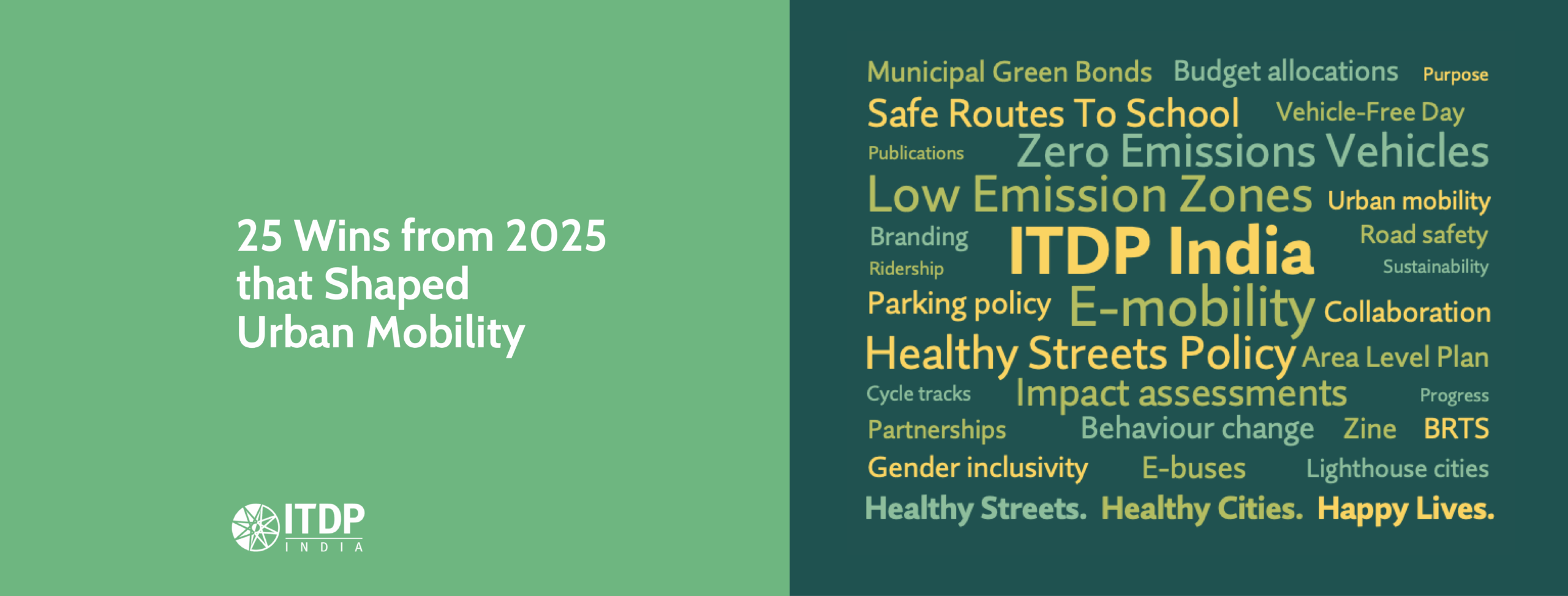
      25 Wins from 2025 that Shaped Urban Mobility

      20th January 2026 by admin


      At ITDP India, everything we do is guided by three goals: Increase public transport ridership, electrify urban transport systems, and secure funding at scale, to make the former two goals possible.
      And what’s our grand vision? People-first, low-emission cities. In 2025, every win was shaped by these three goals, and this shared vision.
      Some wins may look small on their own like a humble brick: a policy here, a budget allocation there, a guideline approved. But stack them together and you start to see the city being built to enable people moving smoothly, one sustainable decision at a time. Check out our crisp listicle on 25 wins from 2025 that Shaped Urban Mobility. This captures the winning moments of everyday work towards the big picture.

      Brick by Brick: 25 Milestones that Shaped Our Cities

      Filed Under: Chennai, news Tagged With: Chennai, Coimbatore, India, non-motorised transport, Parking, parking management, Safe Route To School, Sustainable Transport, Tamil Nadu, Walking and Cycling

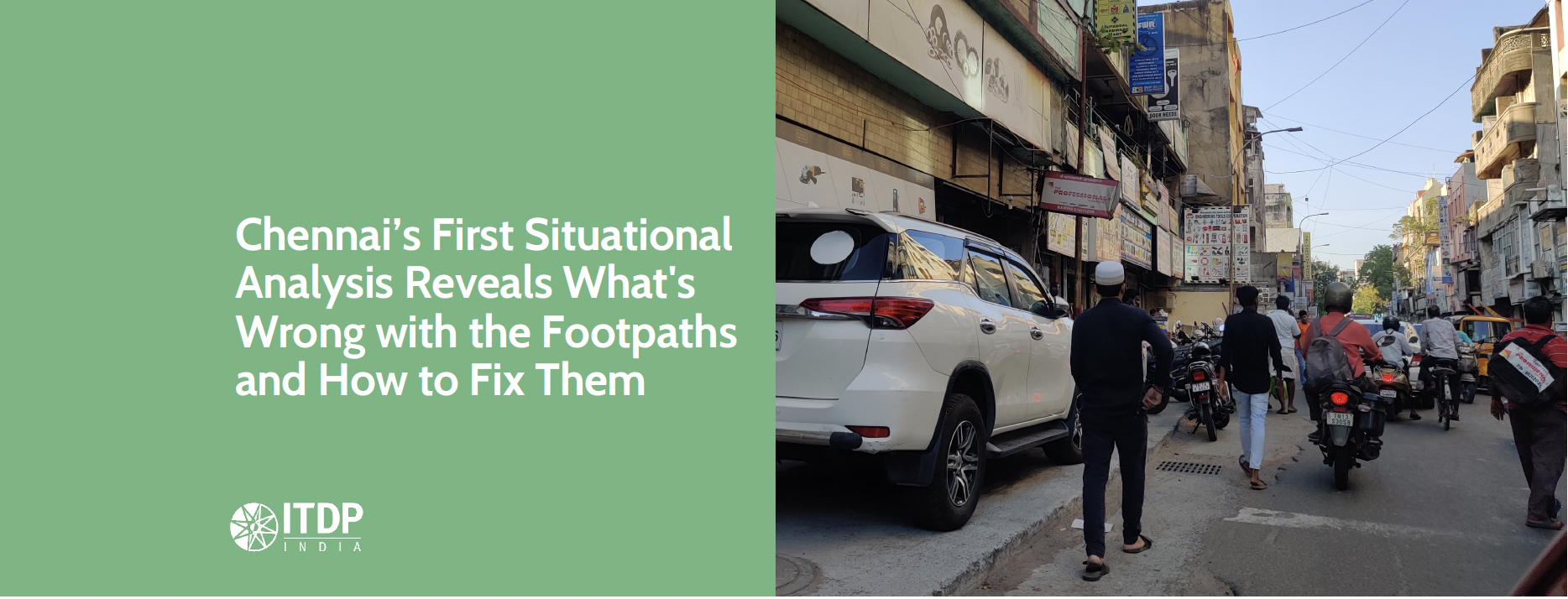
      Chennai’s First Situational Analysis Reveals What’s Wrong with the Footpaths and How to Fix Them

      3rd December 2025 by admin


      Assessments are a part of everyone’s life. Ask a student, a professional, or even a patient, almost everyone is put through a series of tests, to check whether their performance is upto the mark or not. In the same way, don’t you think our cities need a thorough assessment, once every few years? 

      Assessments and analysis can help a lot, as if holding a report card up the face of city decision makers to assess what works and what doesn’t. It is with this thought that in 2023-2024, ITDP India’s team, embarked on an ambitious journey to assess and score the situation of the city’s streets and how walkable they are! 

      But why assess walkability?

      Walking is the most fundamental and natural mobility for most people in the city. It is a birthright for everyone to have and own, and to move, and access different parts of the city, that often gets taken for granted. 

      Picture this in fact! Almost 23% of trips in Chennai are made by ‘walking’, as per the Comprehensive Mobility Plan for Chennai Metropolitan Area (CMP), 2023. However, walking on arterial and sub-arterial (internal) streets continues to pose a high risk for pedestrians.  

      And these risks are translating into fatalities. Between 2019 and 2023, for instance, while Chennai took extraordinary measures to reduce the total number of accidents and fatalities, pedestrian fatalities still constituted a significant number. As per data assessed and analysed by ITDP India, pedestrian deaths made up 43% of all road accident deaths in Chennai. Furthermore, of all pedestrian related accidents in Chennai in 2023, 30% ended up as fatalities. This is an increase from 11% and 22%, respectively in 2019.  

      The above data point is crucial to delve into given that the city adopted the Non Motorised Transport (NMT) Policy in 2014, and it followed through by developing over 170 km of footpaths on key Bus Route Roads. This begs the question; what happened to those footpaths? Are they intact? Are they being utilised as was once imagined? Do they need improvements? These are some of the questions that ITDP India’s latest study, called Situational Analysis of Chennai’s Footpaths, attempts to answer.  

      What is a Situational Analysis?

      A situational assessment aims to understand the current condition of infrastructure in detail, highlighting the merits and demerits of footpaths in comparison to standards. It also builds a good database of the infrastructure and develops a scoring system to prioritise streets where footpaths require immediate attention. The study in Chennai identified 14 streets across different zones of Chennai, in which 32 km of footpaths were mapped and observed, and over 1700 user perception surveys were conducted.  More importantly, this study also provides a framework to analyse the impact of this humble piece of infrastructure on its users, for the future as well.   

      How was Situational Analysis done? What parameters were used?

       Every pedestrian infrastructure was viewed from three dimensions:

      Design Mapping

      How efficient is the design and how well it has adhered to the standards. This was done by using the MerginMaps which uses 14 performance indicators  

      User Perception Survey
      Gathering insights from vulnerable groups (young, elderly pedestrians, cyclists, public transport users) on footpath experience, using 8 indicators. 

      Observation Surveys
      Analyzing traffic volume and user behavior based on 9 indicators of optimal street usage. 

      The data collected was then analysed through the lens of 4 key parameters of Healthy Streets:   

      1. Ease of Mobility – The ease with which pedestrians can walk on wide, seamless, continuous footpaths free of obstructions.  
      1. Safety—The availability of dedicated pedestrian crossing infrastructure, traffic calming elements, a buffer between carriageway and footpath, street lighting, and active property edges ensures pedestrians’ personal and physical safety.   
      1. Universal Accessibility – Inclusion of the vulnerable sections of society, such as the elderly, children, pregnant women, and persons with other physical challenges, through design.  
      1. Livability – A sense of comfort and belonging created by the presence and integration of street play, street commerce, and other socio-economic activities, in addition to providing functional footpaths.   

      What were the key findings of the Situational Analysis?

      The study provides insights into the importance of footpaths as well as having good footpaths to improve their usability.    

      Footpath Design User PerceptionObservation Survey
      Ease of Mobility & Universal Accessibility 55% of footpaths across all streets were found to be of inadequate width.  58% of those who reported that the footpaths are not walkable are women Only 40% of the pedestrians are seen walking on footpaths. Most prefer walking on the carriageway due to obstructions and inadequate design.  
      40% of the total length of all streets lacked a footpath. 
       
      76% of respondents found the streets had several obstructions on the footpath. On average, only 13.21% of modes of commute during peak hours on streets is walking.  
      On average 10 obstructions per 100m and parking constitutes 40% of all the types of obstructions, followed by encroachments like commercial spillover, advertisements, construction debris etc. 
      Safety & Livability Street lights illuminate only 61% of the streets. 
       
      The total number of pedestrian crossing points provided is 50% below the required number per IRC standards. 
      57% of respondents who reported having difficulty crossing the street, and who found it unsafe at night are women 
       
      73% of respondents find streets unsafe to cross, and 71% of them are concerned about speeding vehicles while crossing. 
      Speeds in neighbourhood-level streets are able to go as high as 60kmph. 
      Speed breakers followed by pedestrian crossing points are most effective traffic calming measures observed.  
      48% of all pedestrians are women, showing the need for inclusive design.  

      How did individual streets perform?

      To further make the analysis granular, a scoring framework was used which helped rate the performance of the footpath infrastructure across all 14 streets on all 31 indicators of performance. It also helped identify the nature of intervention required, based on varying performance:  

      1. A street with a rating of 25 or more can be improved through strict enforcement and minor repairs and interventions.   
      1. Streets rated 19 to 25 would require enforcement to remove obstructions, improve footpath surfaces, and introduce accessible crossing infrastructure.  
      1. Streets with a rating of 14 to 19 would require repairs to improve the continuity of footpaths, remove obstructions, and introduce safe midblock crossing infrastructure.  
      1. Streets with ratings below 14 should be redesigned and restructured completely. 

      Here the winning street was Pedestrian Plaza, scoring a brilliant 25.71, whereas the poorest performing street was CP Ramaswamy Road scoring just 12.72 on 30.

      The following inferences can be drawn from the studies, as well as the score card. 

      1. Streets prioritising pedestrians are safer, more accessible, and liveable: Pedestrian Plaza, CSIR, and Wallajah Road have exceeded basic footpath requirements, catering comprehensively to pedestrian needs. 
         
      • Pedestrian Plaza
      • Pedestrian Plaza
      • Pedestrian Plaza
      • Pedestrian Plaza
      1. Continuous and consistent footpath standards across the entire street length are crucial for ensuring ease of pedestrian mobility. Streets such as Sardar Patel Road and Peter’s Road demonstrate that design and perception scores do not align with each other.  
      • Peter’s Road
      • Peter’s Road
      • Peter’s Road
      1. Pedestrian crossings and traffic calming measures should be prioritised alongside footpath provision: Despite adequate pedestrian infrastructure, streets like Perambur High Road, Peter’s Road, and Sardar Patel Road show moderate performance.  
      • Perambur High Road
      • Perambur High Road
      • Perambur High Road
      1. In streets without formal footpaths, stormwater drains double as walking zones but lack pedestrian safety and comfort. This necessitates efficient drainage design for clear walking zones, as is evident in streets such as C.P. Ramaswamy Salai, Anna Main Road, Eldams Road, and Broadway.  
      • Eldams Road
      • Eldams Road
      • oplus_2
      1. The absence of an enforcement/O&M framework results in footpath encroachment, diminishing clear walking zones for pedestrians. Streets that perform fairly, such as Old Jail Road, Thirumalai Pillai, Gandhi Irwin, and Thiru Vi Ka High Road, illustrate this issue as they were all once refurbished under the 170km of BRR road transformation project, benefits of which did not continue due to poor maintenance. 
      • Gandhi Irwin Road
      • Gandhi Irwin Road
      • Gandhi Irwin Road
      • Gandhi Irwin Road
      • Gandhi Irwin Road

      Recommendations for Chennai to improve its network of streets

      Good footpaths are a win-win for all citizens. On one hand it can reduce travel costs for low-income households, on the other hand, it boosts physical health and improves inclusivity by encouraging more women, elderly, children, and vulnerable people to use public spaces. An overarching benefit for all sections is also that it lowers emissions by promoting walking and cycling and can address congestion. The results of the study helped identify key priorities to improve footpaths:  

      Way Forward

      An assessment is good as long as the feedback is implemented on. At ITDP India we are happy to share that the results and recommendations of the study were showcased to the city engineers. This was presented during a workshop organized by ITDP India, focusing on the significance of Healthy Street Design guidelines to enhance footpath design and usability in the city.  

      Capacity Development Workshop for Bus Routes Roads Department in 2024

      Since then, the Greater Chennai Corporation has committed to several initiatives aimed at strengthening pedestrian infrastructure. These initiatives include identifying new networks for footpath repairs and reconstruction, conducting audits to assess the condition of existing street infrastructure, and creating a Standard Operating Procedure (SOP) for the operations and maintenance of the city’s footpaths. To boost these initiatives further, the state allocated a Rs 200 crore budget to build and improve over 200 km of footpaths in Chennai in 2025, which is the first dedicated budget for pedestrian infrastructure. This work is being carried out with technical assistance from ITDP India. 

      It is also pertinent to note that this exercise has been replicated in multiple cities by ITDP India, showcasing a powerful methodology that can be embraced by many more.  

      This isn’t just about rating pavements; it’s about reimagining streets as spaces of safety, accessibility, and shared humanity. The path ahead is clear: Chennai’s footpaths need more than repairs, the city does need to prioritise the scale-up of footpaths across the city. They demand a collective awakening—to see sidewalks not as afterthoughts, but as lifelines. The data is here. The solutions exist. Now, will we walk the talk? 


      By Sanchana S, Senior Associate, ITDP India

      Edited by Donita Jose, Senior Associate, ITDP India
      Filed Under: Chennai, news Tagged With: Chennai, Coimbatore, India, non-motorised transport, Parking, parking management, Safe Route To School, Sustainable Transport, Tamil Nadu, Walking and Cycling

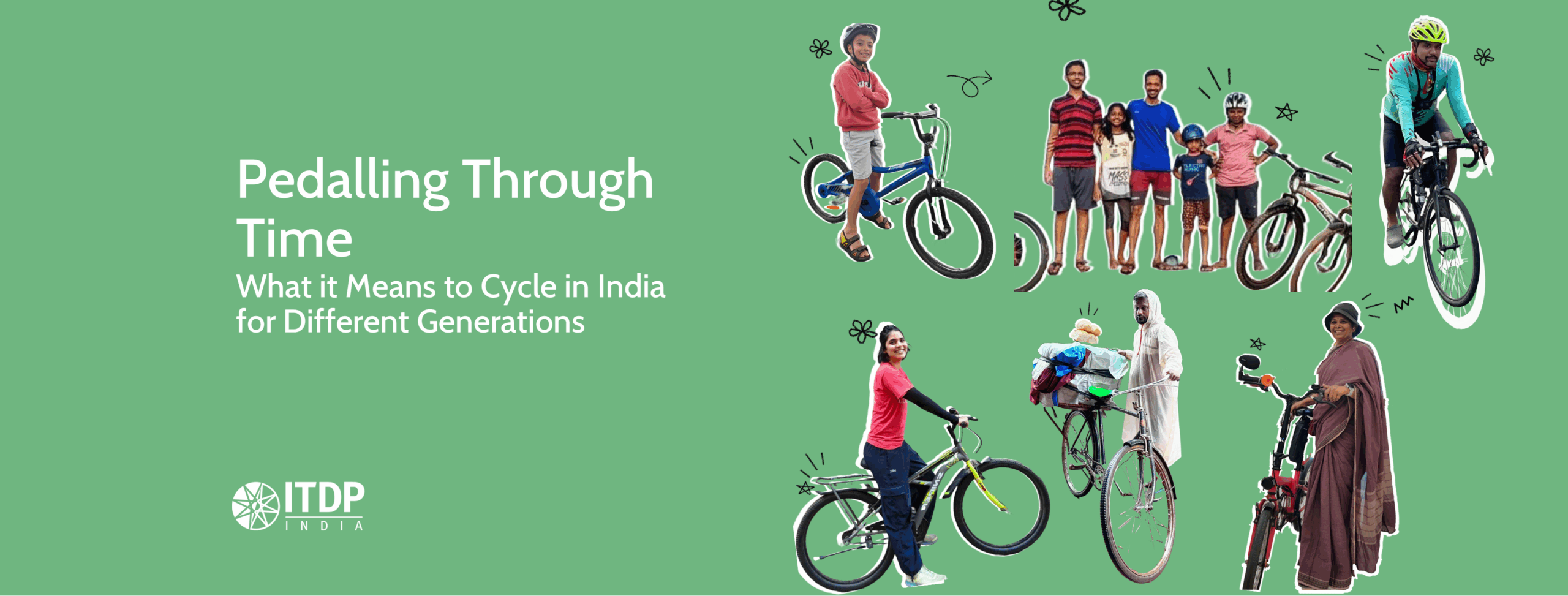
      Pedalling Through Time; What it Means to Cycle in India for Different Generations

      3rd June 2025 by admin


      Cycling has long been woven into the fabric of daily life in India. Just a couple of decades ago, the cycle was an essential part of most households, getting children to school, adults to work, and everyone, everywhere in between. From the wobbly first rides of young kids to teenagers mastering wheelies, to middle-aged men cycling to theatres, to young women pedalling to their colleges, the cycle was more than just a mode of transport, it was part of growing up, working, and living. 

      But as motor vehicles have come to dominate our streets, the space for cycles, both physical and social, has shrunk. Yet, across India, many continue to hold on to this two-wheeled connection. This World Bicycle Day, in this blog, we bring together stories from different corners of the country, spanning age groups, genders, and backgrounds, to understand what cycling means to people today. 

      Whether it’s riding over speed bumps for the thrill, cycling for fitness or weight loss, pedalling to earn a livelihood, or simply chasing the joy of childhood, these anecdotes remind us that cycling still belongs to everyone. 

      Karl Dubash, 7 years old, Chennai 

      “I’m Karl and I’m 7 years old. My cycle is blue and black. I used to have a bell, but it broke. I haven’t given my cycle a name yet. I usually ride around my apartment. I go out cycling about two to three times, and mostly every evening. I like riding fast! My favourite part about cycling is going past the speed breakers and riding in a zigzag. It’s super fun!

      Sometimes I go cycling with my friend Akshay in Basham. We ride all around the apartment. I also go with my mom and sister. I remember my first cycle! It was light blue and white, and it had a koala on it. I liked it right away. To learn how to ride, I watched my mom and dad and kept practising. It was a bit hard at first, but once I got my balance, I was very happy. I don’t find the roads scary because my mom doesn’t let me go on them. But yes, I think they are scary. I don’t go on the roads at all, so there aren’t any places I avoid. If I could change something to make cycling better, I would wish for cycle paths like the ones in other countries. I wish we had a few in India too!” 

      Kid bikers, 7,10,11 & 15 years old, Kallakurichi

      We are the kid bikers from Kallakurichi: Aadhav (7) on a dark blue and green cycle, Ashvitha (10) on a grey one, Aadhithya (11) riding blue, and Suriya Narayanan (15) on green. We’re four cousins who spent the entire summer pedaling through our town, and we think we’re the coolest cycling crew around!

      What we enjoy most is exploring new roads, cycling down unfamiliar lanes and discovering more about our hometown as we go. Sometimes we even end up covering 10-30km just like that!

      If you ever spot us, we ride in a neat line, like ants in a trail, one behind the other, matching each other’s speed. Well, almost! Every now and then, Aadhithya gets excited and zooms ahead when the street is clear. Infact, we even use hand signals like professional riders and also use aerodynamic techniques to speed.

      Two of us (Aadhav and Ashvitha) have been cycling for over three years now. And through all our rides, one thing we keep wishing for is a dedicated cycle path, lined with shady trees to make the ride smooth and breezy. Our parents often tell us how they cycled to school with their friends, and we dream of doing the same. We’ll keep cycling no matter what, but we know many of our friends would join in if there were safe cycle tracks. We hope that wish comes true someday!

      Saba Serkhel, 29 years old, Mumbai

      “I’m Saba Serkhel, 29 years old. I work as a video and film editor, but when I’m not at my desk, you’ll probably find me sketching, reading or cycling. My relationship with cycling goes way back. I got my first tricycle when I was three, and by the time I was seven, I had my first proper bicycle. It was a hand-me-down from my sister—a bright pink cycle covered in flowers.


      At the time, I wasn’t too happy with the design, but that didn’t matter. What mattered was what it gave me; my first taste of freedom. I still remember the exact moment I learnt to ride. My sister ran alongside me, holding the back of the seat, cheering me on. And then suddenly, I was flying solo. That rush, that feeling of “I can do this on my own,” has never left me. Learning to cycle remains one of my most treasured memories. 

      Even now, every time I ride, I’m reminded of that moment. For me, cycling has always been more than just physical exercise, it is a return to that feeling of independence. It’s a way to break away from the noise, the traffic, and the pressure of city life. 

      Living in Mumbai, that escape matters a lot. The roads are chaotic, packed with illegal parking, potholes, encroachments—and there’s little room for cyclists. But every other weekend, I carve out a slice of calm for myself by heading to Sanjay Gandhi National Park. There, I ride through shaded trails, under towering trees, past monkeys and the occasional deer. For a while, I can just breathe. That’s the kind of escape cycling gives me. 

      Over the years I have cycled in other cities too like Athens in the U.S., Ahmedabad, Bilaspur, and each place brought its own vibe. Athens had proper lanes and was safe despite the hills. Ahmedabad’s wide, pothole-free roads surprised me. And Bilaspur, with its rural quiet, felt like peace on wheels. But Mumbai…Mumbai makes you work for it. You have to be stubborn to cycle here.  

      My current cycle is green and black, and I call it Bill, after the long-tailed Broadbill. It’s fairly new, but like every bike I’ve ever had, it gives me the freedom and the escape, and always, a quiet reminder of a little pink bicycle, a running sister, and the first time I truly felt like I could do anything.” 

      Kasim Bammanalli, 33 years old, Panaji

      “I’m 33 years old and I work as a poder which is a traditional Goan breadmaker. Every day, I deliver freshly baked bread and poi from the bakery to people’s homes, cycling through the neighbourhood, carrying a basket of warm bread on my cycle. I’ve been cycling for the past 17 years. Twice a day, every day, once in the morning and then again in the evening. I follow the same familiar route. It’s a routine I’ve gotten used to, and my black cycle is always with me. 

      I haven’t given it a name, but it’s like my companion now. Simple, sturdy, with a rack to hold my bread basket.Cycling isn’t something I find physically hard. My hands and legs don’t hurt. Sure, it’s a tough job, but the effort I put in is what I earn from. That’s how I look at it. As for safety on the road, there is not much I can do as I have to cycle, no matter what. Everything else is in God’s hands. Accidents happen. If someone crashes into me, it’s on them. If I hit someone, that’s my responsibility. That’s just how it is. 

      For me, cycling is not about fitness or fun. It’s part of my work, my livelihood. If the cycle breaks down, our employer takes care of it. Every couple of months, they call in a maintenance person to check all the cycles and fix whatever needs fixing. People often talk about improving cycling in the city by adding dedicated cycle lanes. But why would anyone add it just for me? And can it even be added on every street? For safety, I just stick to my route. Infact, I’ve cycled through fields, on busy roads, wherever needed. If traffic gets too heavy, I pull over and wait. I just do what I have to do. 

      I still remember my first cycle—it was an Atlas. Very sturdy, very reliable. Much better than the new models today.” 

      Karthik, 43 years, Chennai

      “I took up cycling back in 2014 when I hit 116 kg and knew I had to make a change. What started with short weekend rides of 20–25 km slowly became a serious fitness routine. Initially, I was just trying to shed weight and get healthier. But things really changed when I joined the Chennai Cyclists group in 2017. With local chapters spread across the city, it became easier to ride regularly and meet like-minded people.  

      Over time, I started participating in endurance rides like 100 km, 200 km, and eventually timed long distance events upto 555km and 600km. These rides are self-supported and test your planning, time management, and resilience.  

      What started as a solo fitness goal has turned into something bigger—a community, a lifestyle, and a constant learning curve. 

      But cycling in a city like Chennai isn’t easy. We often ride on highways like ECR where reckless driving is a real threat. There’s no dedicated infrastructure, over speeding, and unruly traffic make every ride a risk. We try to stay safe by riding in a disciplined formation, following lane rules, and constantly looking out for each other. Still, with so many overlapping infrastructure projects and road conditions always changing, cyclists like us are left navigating a city that isn’t built for us.” 

      M Nagalakshmi, 58 years, Hyderabad

      “My relationship with cycling has been a lifelong one, but I only resumed cycling regularly a few years ago, probably around the time I turned 50. There wasn’t any big reason or trigger. I just felt like it was time to reconnect with the child in me. And what better way than to get back on a cycle? I still remember my very first one, it was a hand-me-down, electric blue, and I rode it to school every day. These days, I ride to work, meet friends, and even just to get out and feel the breeze on my face. 

      Over the week, I usually cycle nearly 30-40 km for leisure. Apart from this, I cycle to the office, which is about 3–4 km away, unless the weather is too harsh or I’m wearing a saree. That’s where things get tricky. Most cycles today are built like sports equipment. Not very commute-friendly. Not women-friendly. Definitely not saree-friendly. Earlier, I had cycles designed in a way that it was comfortable for dresses. Now, what dominates the market are “performance bikes,” often with designs that exclude Indian women altogether. My saree gets caught in the chain. Pants get caught, too. It’s frustrating. We can’t romanticise this, as the industry is ignoring the reality of women cyclists. 

      Another big issue? Wrong-side driving. In some places, two whole lanes are taken up by vehicles coming the wrong way. It’s not just inconvenient—it’s dangerous. That’s been one of the biggest changes I’ve seen in recent years. 

      I really believe more people would take up cycling, like women, older adults, everyone, if cycles were actually designed for us. We need age-friendly and gender-friendly options. Something with side support, maybe even battery-powered cycles, so that riding stays fun and helps us stay mobile. And from the city’s side, we don’t need fancy cycling tracks, just better speed regulation, stricter enforcement against wrong-side driving, and maybe some traffic lights that actually prioritise cyclists.” 


      By Donita Jose, Senior Associate, Communications ITDP India and Shreesha Arondekar, Associate, Development and Communications, ITDP India

      Filed Under: news, Walking and cycling Tagged With: Chennai, Coimbatore, India, non-motorised transport, Parking, parking management, Safe Route To School, Sustainable Transport, Tamil Nadu, Walking and Cycling

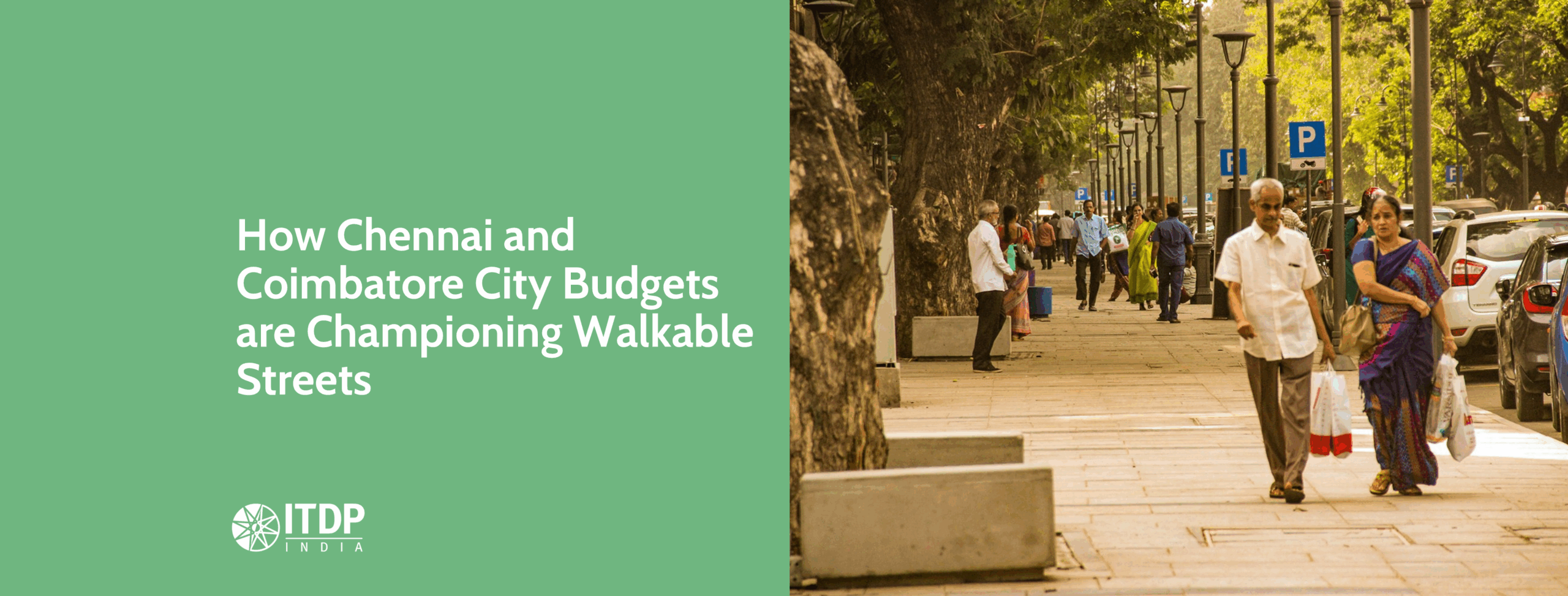
      How Chennai and Coimbatore City Budgets are Championing Walkable Streets

      20th May 2025 by admin


      For years, major cities in Tamil Nadu have prioritised vehicles through budgetary allocations and infrastructure. This is despite the fact that two-thirds of all trips in the state are made by walking, cycling, or using public transport. This year, however, the tide is turning. The Tamil Nadu Budget 2025 marks a pivotal shift with Chennai and Coimbatore taking the lead, placing Non-Motorised Transport (NMT) —like walking and cycling—at the heart of mobility planning, and reimagining streets as spaces for people, not just cars. What sets this budget apart is not just the scale of funding, but the values it reflects—equity, safety, and access for all. 

      While this development is a step in the right direction and is still in its nascent stages, Chennai’s strides towards creating walking and cycling friendly streets echo some of the early moves seen in cities like Singapore. Singapore has long been a role model for Southeast Asia, known for its  integrated public transport and walkable, people-friendly streets, backed by landmark investments like the 1 billion Singapore Dollars’ fund for last-mile connectivity in 2016, and forward-looking policies such as the Active Mobility Act (2017) and Multi-Modal Transport Act (2021). Anchored by the Tamil Nadu Budget 2025, which earmarks significant investments in footpaths, smart parking, and Safe Routes to School pilots, Chennai’s journey could chart a similar course—if implementation keeps pace with vision. 

      A Historic Leap for Walkability in Chennai 

      A landmark first – ₹200 crore dedicated funding for 170 km of footpaths in Chennai  

      This year’s budget has earmarked ₹200 crore for the implementation of 170 km of high-quality footpath in Chennai. This is the largest investment for pedestrian infrastructure in the city to date, and the first time since the Non-Motorised Transport (NMT) Policy of 2014 that footpath development has received such focused financial backing. Announced by Hon’ble Minister K.N. Nehru on March 25, 2025, this move is more than just a line item in a budget—it is a powerful reaffirmation of the state’s commitment to safer, more inclusive streets for all, especially vulnerable road users including children, the elderly, and Persons with Disabilities (PwDs).  

      Chennai’s journey: From marginal to meaningful investments!

      Chennai’s journey toward walkable streets began with ambition. Following the adoption of its pioneering Non Motorised Transport Policy in 2014  the city saw average annual footpath investments rise to ₹72 crore, resulting in the creation of over 170 km of footpaths between 2014 and 2019—most of it funded through the Tamil Nadu Urban Road Infrastructure Fund (TURIF). During this time, the city also tapped into the Smart Cities Mission’s Area-Based Development (ABD) funds to implement the now-celebrated Pedestrian Plaza and its feeder streets in T. Nagar.    

      Citizens walking safely on Pedestrian Plaza

      To scale up its efforts, Chennai launched the Complete Streets program in 2020 (earlier known as “Mega Streets”) with a dedicated ₹100 crore allocation under the Chennai City Partnership with the World Bank. The project aimed to reimagine neighbourhood-level street networks by integrating underground utility upgrades and walk and cycle-friendly above-ground infrastructure. However, the first implementation phase, under progress, covers only around 11 km, leaving behind the demand for a city-wide network of functional footpaths largely unmet.   

      Ongoing implementation under the Complete Streets Project at Khader Nawaz Khan Road, Nungambakkam

      Analysing the budgetary spending, we found that from 2022 to 2025, Chennai’s investment in footpaths plummeted to just ₹13 crore per year on average. A modest recovery came in FY 2024–25, with ₹25 crore earmarked for 21 km of footpaths, but this was still far from enough to undo years of underinvestment.  

      Source: Budget Expenditure categorised by type of work and scheme, FY 2012 – January 2025 (Bus Route Road Department)  

      However, our analysis also pointed out that over all these years, road resurfacing and carriageway upgrades continued unhindered, reflecting an annual average spending of ₹84 Crores, and a consistent focus toward vehicle-centric planning.  

      Source: Budget Expenditure categorised by type of work and scheme, FY 2012 – January 2025 (Bus Route Road Department)  

      A renewed push: Bringing safety and equity to the forefront 

      Any policy without dedicated, sustained funding is just a wish. For Chennai to become truly walkable, sustained investment and quality implementation must now follow the city’s renewed aspirations, and 2025 marks a good beginning with this significant dedicated allocation for NMT infrastructure. Analysis of spending patterns on NMT infrastructure over the last three years, reveals that footpath implementation in Chennai relied on piecemeal funding drawn from state and city-level schemes—such as the Tamil Nadu Urban Road Infrastructure Fund (TURIF) and Singara Chennai 2.0. In the absence of a dedicated budget, investments in Non-Motorised Transport (NMT) remained inconsistent and limited in scale. This year’s ₹200 crore commitment by Chennai, marks an eightfold increase over last year’s spending on walking and cycling. This signals a much-needed shift from fragmented support to focused investment.

      This renewed focus on walkability couldn’t have come at a more critical time. While Chennai has made commendable progress in reducing overall road crashes, the proportion of pedestrian fatalities has seen a troubling rise from 11% in 2019 to a staggering 43% in 2023.  

      Source: Road Accidents Reports (2019-2022), MoRTH & Road Accident Analysis in Tamil Nadu 2023, TNSTC  

      This persistent gap between mobility patterns and infrastructure safety highlights the urgent need for course correction, which this budget begins to address. The ₹200 crore allocation is a long-overdue shift toward building streets that are shared public spaces where everyone can move freely and safely. To transform this intent into tangible impact and ensure that the budget is effectively utilised, aligned with diverse mobility initiatives, and executed on time, a dedicated coordinating agency like the Chennai Unified Metropolitan Transport Authority (CUMTA) is crucial.  

      Bringing It All Together: CUMTA as the institutional backbone  

      Much like Singapore’s shift to a car-lite city was steered by its Land Transport Authority through various institutional reforms and proactive policymaking, Chennai’s mobility transition is now gaining momentum through the leadership of the Chennai Unified Metropolitan Transport Authority (CUMTA). With a clear mandate to coordinate mobility efforts across the Chennai Metropolitan Area (CMA), CUMTA is emerging as the anchor institution for Chennai’s people-first mobility vision. 

      As part of the Budget 2025, Honourable Minister for Housing & Urban Development, Thiru S. Muthusamy announced an array of progressive initiatives led by CUMTA.  

      • Building on the newly adopted Parking Policy, CUMTA will pilot Smart Parking Management in Anna Nagar, reclaiming public space and improving local access. 
      • CUMTA is also developing Comprehensive Street Design Guidelines for the entire Chennai Metropolitan Area—including Tambaram, Avadi, and Kanchipuram—to create safer, more inclusive streets across jurisdictions.  
      • Complementing this, CUMTA is also drafting the Traffic Impact Assessment Guidelines to help cities manage congestion and ensure new developments align with sustainable transport goals.  

      These initiatives go hand-in-hand with Tamil Nadu’s growing investment in Non-Motorised Transport—signalling not just a shift in budget priorities, but a change in how cities are planned and governed. With institutions like CUMTA at the helm, Tamil Nadu is building long-lasting systems to realise its people-first mobility vision. 


      Coimbatore Steps Up: Scaling Sustainable Mobility Initiatives 

      Building on Chennai’s momentum, Coimbatore is making its own strides towards a more people-centric mobility scenario with this year’s budget embedding sustainable mobility into the city’s planning priorities. Two key initiatives are set to guide this: revising the Coimbatore Street Design Guidelines and developing a comprehensive NMT Action Plan. These tools will help the city set a strong foundation for designing safer, more inclusive streets at scale. 

      Coimbatore has been grappling with concerns on road safety, with road fatalities rising over 1000 in 2023; ranking highest in the state. In addition to various other initiatives to address this, a ₹2.5 crore allocation has been announced for a Safe Routes to School pilot on Trichy High Road, covering 2.5 km of critical access routes. Together, these moves reflect Coimbatore’s growing commitment to creating well-planned, safe, walkable streets and mark a step forward in scaling sustainable mobility across Tamil Nadu. 

      A Decade of Partnership: ITDP’s Ongoing Commitment 

      Since 2009, ITDP in India has worked closely with the Greater Chennai Corporation (GCC), Chennai Unified Metropolitan Transport Authority (CUMTA), and Coimbatore City Municipal Corporation to help shape their sustainable mobility vision.  

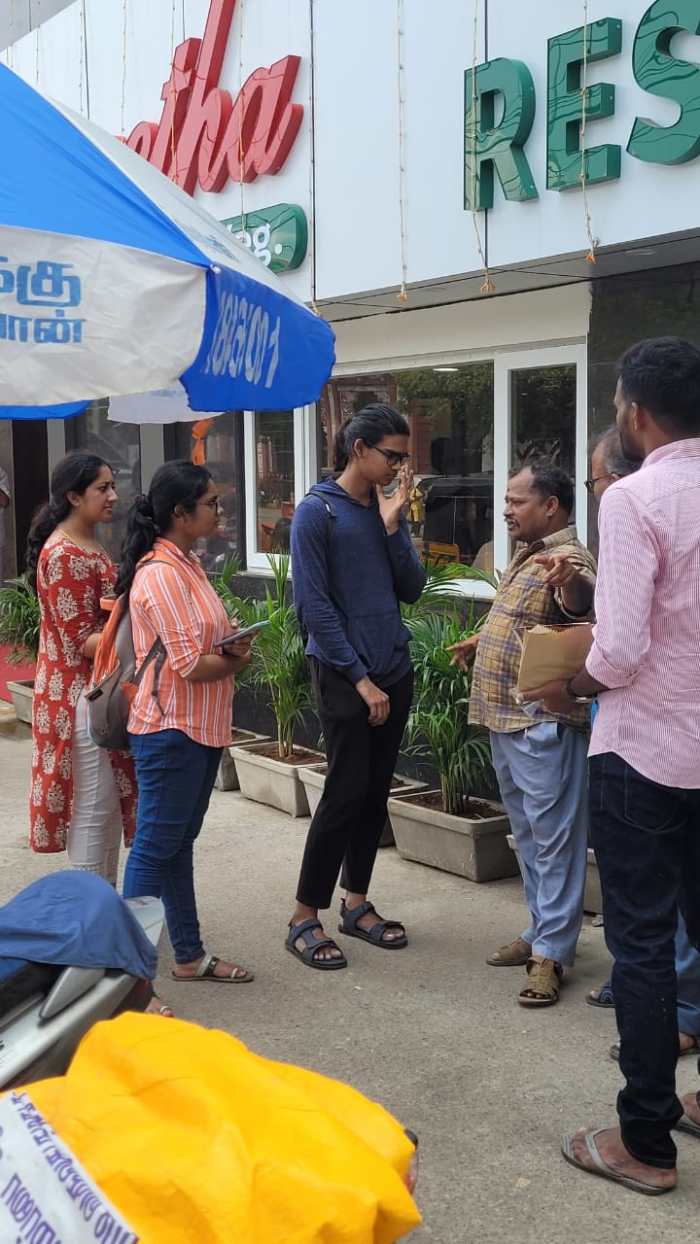
      Over the years, ITDP has supported with technical research and guidance on key policies and guidelines adopted by city governments, such as the Non-Motorised Transport Policy, Parking Policy, and the Complete Streets Framework. We are also continuing to help cities build the capacity to implement them through on-ground workshops, experiential street audits, and engagements with city leaders. Our role has also included providing technical support and data-driven insights to guide decision-making and strengthen the case for healthier, more equitable streets. 

      We are happy and proud to have contributed to realising these milestones and are extremely grateful for the past and present city leadership for their sustained support in championing these initiatives. 

      Capacity Development Workshop for Bus Routes Roads Department in 2024

      A Win Worth Celebrating—and Building On 

      These announcements are worth celebrating, especially for cities like Chennai and Coimbatore, that are leading this change at the forefront. However, the real measure of success lies in how well we translate this vision and intent into long-lasting impact on the ground. 

      Here are a few pointers for the city governments to make this fruitful:  

      • Chennai’s ambitious plan to implement 170 km of footpaths must be guided by a clear network planning strategy and aligned with CUMTA’s Comprehensive Mobility Plan. 
      • Bringing on board qualified technical experts and consultants will be key to ensuring street designs meet the standards laid out in the city’s adopted guidelines. 
      • Facilitating capacity building for contractors and engineers is equally important to ensure high-quality street implementation. Field engineers must closely monitor implementation quality using well-defined performance indicators to ensure accountability at every step.  
      • Cities must also embed Operations & Maintenance (O&M) systems right from the planning stage, to ensure infrastructure remains functional and safe for all users. 
      • Annually recurring budgets for NMT including dedicated budgets for O&M must be institutionalised, so cities can plan consistently and scale.  
      • One persistent challenge our cities face is siloed execution, where lack of co-ordination leads to utility works disrupting newly built footpaths and guidelines/policies exist on paper without enforcement. Addressing this will require strong inter-agency collaboration, clear mandates, and sustained leadership from institutions like CUMTA. 

      Chennai and Coimbatore have taken a significant first step. Now, they must stay the course—scaling these successes across other cities of Tamil Nadu, building systems, and creating streets where walking, cycling, and shared mobility are not just possible, but preferred. 


      By Varsha Vasuhe, Senior Associate, ITDP India
      Edited by Kashmira Dubash, Deputy Director, ITDP India

      Filed Under: Chennai, news Tagged With: Chennai, Coimbatore, India, non-motorised transport, Parking, parking management, Safe Route To School, Sustainable Transport, Tamil Nadu, Walking and Cycling

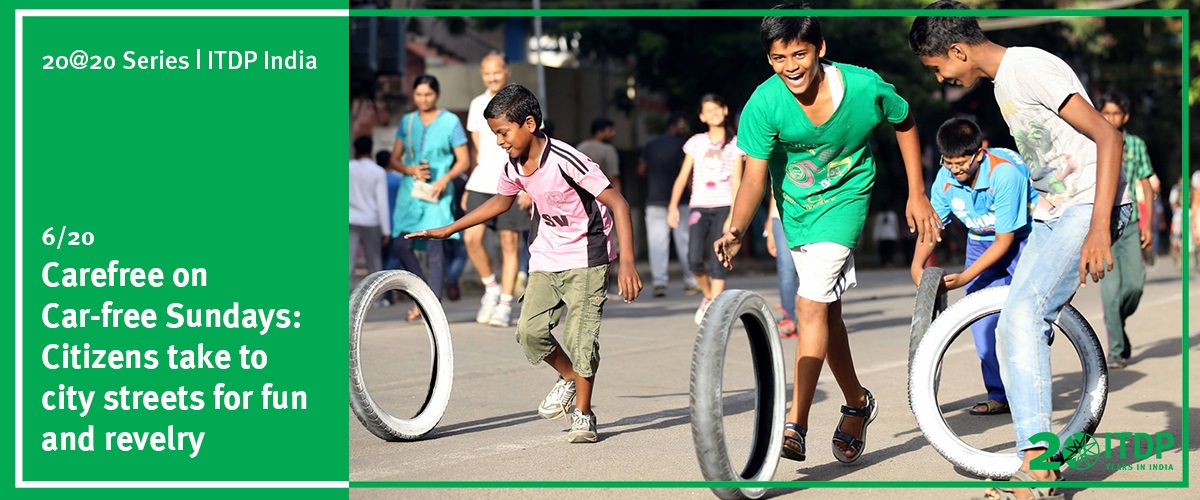
      Carefree on Car-free Sundays: Citizens take to city streets for fun and revelry

      9th August 2018 by admin

      Imagine an arterial road in your city. Now, place a child running about in that stretch. Fair to assume that your brows twitched at the thought of these two events aligning. Though stark, urban dwellers are naturalised to the danger that arterial roads or streets in general hold. But to hold a static entity accountable is unfair. So where does the buck stop?

      Let’s reimagine this sequence of events. Same arterial city road and same child running about carefree. This time though, cordon off vehicles from the section. Suddenly, the road seems to be devoid of chaos. It even becomes an oasis where people can come together to run, play, and enjoy themselves to their heart’s content.

      Isn’t it bewildering how one component can drive our stress up the walls and still be considered an integral part of our lives. This is exactly what the “Car-free” initiative was conceptualised to debunk. Originated in the Netherlands and Belgium during the 1956 Suez Crisis, the move was planned to ration petroleum. But it took its true form in 1958, when New York City residents blocked vehicles into their neighbourhood to protest the extension of a road at the cost of a public space.

      As vehicles started taking over our streets and lives, the initiative gained prominence to counter this menace. And it is with the same intention that the initiative made its way into the Indian quarters. The “Car-free Sundays” drive, proposed by ITDP India Programme in collaboration with Riverside School and other partners, was first introduced to Ahmedabad in 2009. Every Sunday, citizens were given unconditional access to three arterial stretches to experience the freedom of walking and cycling on safer car-free streets.

      India’s first car-free Sunday in Ahmedabad in 2012

      It wasn’t long before other states recognised the transformative nature of the initiative. Tamil Nadu and Maharashtra were quick to come on board and transform their streets into vibrant spaces for citizens, not vehicles, to occupy.

      Leading the charge in Tamil Nadu was Coimbatore. The dialogue, facilitated by ITDP, was a success. All partners –including the Coimbatore City Municipal Corporation, Residents Awareness Association of Coimbatore (RAAC), print media partners and the residents– realised that the concept would help improve walking and cycling conditions in the city.

      The Corporation and the Coimbatore Police left no stones unturned to help citizens reclaim landscape lost to vehicles. With prior public consultation workshops for residents, the campaign was launched across two stretches –DB Road and T V Swamy Road– for a total of 1.7km, in 2015. This sense of emancipation was refreshing, as many came in droves to be part of the revelry. Soon accolades started pouring in, with the campaign being honoured with the Best Project Award, Non-Motorised Transport category, by India’s National Ministry of Urban Development.

      People enjoying hop-scotch at the car-free Sunday in Coimbatore

      The obvious impact was soon realised by Chennai and it didn’t take much for city officials and the police to join the bandwagon, with ITDP again playing a hand holding role in collaboration with Chennai City Connect and The Hindu (media partners). Titled “Namma Chennai Namakke” (Our Chennai for Ourselves), many residents took an instant liking to the idea.

      “I would love to see children aimlessly ride their cycles on the road…or adults playing badminton and pet enthusiast take their companions for a walk. I personally would indulge my pet, without the fear of him/her getting hit by a car,” said Jennifer Jacob-Murali, resident of Chennai.

      Father and daughter bonding over skipping at the car-free Sunday in Chenani

      Every Sunday, the ruckus of vehicles were replaced by that of laughter and excitement. Of kids being kids and parents joining the act. Of people dancing, doing yoga, and enjoying art and craft. Of citizens, young and old, not surrendering their right to walk, run, and cycle to the chagrin of fuel guzzling automobiles.

      Today, these cities have taken a step ahead towards sustainable urban transport solutions with Chennai adopting a Non-Motorised Transport Policy and Coimbatore adopting the Street Design and Management Policy. Car-free Sundays helped citizen to wake up to the possibility of enjoying public spaces like roads and streets without the hindrance and dread of vehicles. Its success gave momentum to the ‘Model Roads’ project, as citizens demanded better walking and cycling infrastructure across Coimbatore.

      Not even John Lennon could have imagined how vehicles would take over lives, leaving us struggling to find our way. So an ode to his legendary vision, with a twist of our own.

      Imagine there are no vehicles
      It’s easy if you try
      No fumes around us
      Only people and the sky
      Imagine all the people living for today

      Cover image courtesy: Times of India, Coimbatore.

      Filed Under: featured Tagged With: Ahmedabad, Car free sunday, Chennai, Coimbatore, Footpath, Sustainable Transport, Transit Oriented Development, Walking and Cycling

      ITDP India – Our Journey from a Dream to Reality

      team ITDP

      11th May 2018 by admin

      It was back in 1998 that ITDP began its engagements in India, inspired by Mahatma Gandhi’s words, “Be the change that you wish to see in the world.” What started as one woman’s journey to change the dystopian path our cities were drifting towards has transformed into a formidable force of young, passionate visionaries who strive to bring back life in a place we call home. Today, ITDP celebrates two decades of action on the ground, catalysing tangible transformation at scale in over a third of urban India.

      Transportation is the focus of many pressing issues facing the world today—decisions about whether to build highways or bus corridors have a great impact on our health and our planet. For this reason, ITDP has worked with over 18 Indian cities to reduce the human impact of transport choices: ensuring cities put people before cars, all citizens can walk and cycle safety, and jobs and services are a bus ride away. Through the dedicated efforts of our team and a strategic approach towards sustainable transport, ITDP India programme has impacted the lives of millions for the past 20 years.

      ITDP in India

      The journey in India began in Agra. The vision to develop a modern cycle rickshaw to counter the growing threats of motor vehicular pollution, gave way to the India Cycle Rickshaw Improvement Project. What started off as five prototypes has become sustainably embedded as the standard design in cities across North India. Today, around half a million of these modern cycle rickshaws serve  4-5 million zero-carbon trips daily and offer dignified livelihood to over a million people, transforming the lives of their families as well.

      Cycle rickshaws

      ITDP realised the need to transform the quality and availability of public transport in Indian cities. Since 2003, the India Programme evangelised the idea of the Bus Rapid Transit (popularly known as BRT) to transform mediocre bus services into high-quality mass transit.

      Ahmedabad, Gujarat’s largest city, welcomed ITDP to reimagine bus transit in 2005. Our partnership with Environment Planning Collaborative, and thereafter with CEPT University and the Ahmedabad Municipal Corporation resulted in the launch of Janmarg (in 2009)—India’s first high quality BRT system that expands to a network of 87 km. Janmarg has inspired many cities in India, and with guidance from ITDP, five cities have created 200 km of high-quality BRT to date.

      janmarg

      In 2009, the India Programme revolutionised the way people perceived streets in India. Safe, child-friendly streets are not just a mirage of the past, but can be a beautiful reality even today. Ahmedabad was the first city in India to host Car-Free Sundays in collaboration with ITDP, Riverside School and other partners.  The initiative allowed citizens to experience the freedom of walking and cycling on safer car-free streets.  The success enabled expansion to Tamil Nadu and Maharashtra to raise awareness and transform their streets into places we all dream of everyday.

      ITDP India Programme initiated collaboration with Chennai City Connect in 2009 to improve cycling and walking conditions across the city. Change isn’t easy in cities where the car is a symbol for status. But within five years of ITDP’s engagement with the city, Chennai took the bold move of adopting the Non Motorised Transport (NMT) Policy—first in India.

      The policy mandates that a minimum of 60 percent of of transport funding to create and maintain walking and cycling infrastructure in the city. Having retrofitted over 50 km of walkable streets over the years, Chennai has initiated the next phase of redesigning an additional 50 km of street network. Chennai’s policy has inspired many national and international cities—from Chandigarh to Nairobi—to adopt similar policies. The comprehensive approach undertaken by Chennai, was awarded the Sustainia Award in 2015.


      chennai complete streets

      Since 2013, the India Programme has worked with the smaller cities of Tamil Nadu – Coimbatore, Trichy, Tirupur, Salem, and Madurai.  In Coimbatore, the Namma Kovai Namakke (Our Coimbatore Ourselves) campaign, initiated by ITDP, sparked citizen demand for better pedestrian facilities. Coimbatore was the first city in Tamil Nadu to host Car-Free Sundays, that inspired Chennai and Madurai to do the same. The city also adopted The Coimbatore Street Design and Management Policy that aims to increase walking, cycling and public transport use. In light of Coimbatore’s vision to improve people-mobility, the city has planned a 30 km-network of walking and cycling paths to connect the city’s major lakes, in line with the guiding Policy.  

      The India programme began its engagements in Maharashtra in 2009, first with the Municipal Corporations of Pune and Pimpri-Chinchwad, and thereafter in Nashik and Aurangabad. Today, Pune is the epitome of a smart Indian city. Pune launched 40 kms of the Rainbow BRT in 2015, with an additional 45 km in the pipeline. The city adopted the Urban Street Design Guidelines and plans to redesign 100 km of streets based on the world-class standards set by the transformation of  JM Road and DP Road pilot project.

      While Pune has taken the first steps towards developing a people-centric city, the next challenge is to address the encroachment onto footpaths by parked vehicles. As a result, Pune adopted the Public Parking Policy to regulate parking, in 2018. The Policy aims to manage on-street parking through an efficient paid parking system but exempts bicycle parking from any charges. Pune realises that encouraging cycling reduces CO2, improves commuters’ health and increases retail visibility. As a result, the city plans to implement a dockless Public Bicycle Sharing system of 13,100 cycle, under the city’s Bicycle Plan.  Yes, the city has worked wonders. Pune, Chennai, and Coimbatore – all cities ITDP assisted, were selected in the first round of the national government’s Smart City Mission.  

      Pune complete streets

      In 2013, the India programme also expanded to Ranchi, the capital of the state of Jharkhand. Local conditions were unfavourable to support sustainable transport; thus, ITDP initiated collaboration with local civil society groups, educational institutions and trade associations that formed the Ranchi Mobility Partnership. Ranchi’s Mobility for All action plan prepared by ITDP, with input from the partners, provided a detailed roadmap of transport solutions for local conditions.

      The action plan inspired the city to take responsibility of overseeing operations of 100 new buses, and an additional 300 buses in the due course—an applaudable move for a city that had fewer than 30 buses. The plan also identified a cycle network to improve access to public transport; as a result, the city is in the midst of constructing the state’s first Bicycle Sharing system comprising of 1200 cycles.

      Onward and upward, Ranchi’s Parking Policy has inspired other cities in the state, like Jamshedpur, to manage on-street parking. The State too realised the chaos caused by unregulated parking and thereafter adopted the  Jharkhand Parking Regulations—first in India. Jharkhand is also the first state to endorse the Transit Oriented Development Policy that was prepared in consultation with ITDP India.

      On account of leveraging the sustainable transport agenda at the national level, the India expanded to the country’s capital, Delhi, in 2016. This gave rise to the policy brief on Women and Transport in collaboration with Safetipin and UN Women. Women represent the largest share of public transport users, yet they face many barriers that limit their mobility such as safety, comfort, convenience and affordability. Empowering women in transport enables them to participate in workforce, thereby creating a societal shift to transform the entire world economy.

      The India Programme’s capacity development work, through training workshops and study tours, has been imperative to the success of its projects and policy. The India Programme has trained over 1000 government officials and other stakeholders. Over the years, our knowledge products have not only been used for best practise references, but also endorsed by the government – for example, the National Guidelines for Public Bicycle-sharing for the Ministry of Urban Development, and Street Design and BRT Guidelines for the Indian Roads Congress (IRC).

      capacity development

      Since 1998, ITDPs’ agenda of improving the quality of life of citizens through equitable and sustainable transport has only magnified in momentum over time. Times have evolved, but our dream remains the same. Take a moment and imagine a 2050: will we design a future where we continue to get trapped in endless traffic while pollution destroys the city, and infrastructure fails to deliver? Or, will we live in ‘smart cities’ where people can zip around town, connected with walking and cycling boulevards and world-class rapid transit. The choice is yours; we chose the latter.

      P.S. Dear Mahatma Gandhiji, we are being the change we wish to see in the world today. And, we have been doing it successfully for the past 20 years in India!  

      Filed Under: news Tagged With: Ahmedabad, Bus Rapid Transit, Chennai, Coimbatore, Complete Streets, Cycle sharing, Delhi, Footpath, Gender, Nashik, NMT, Parking, Public Transport, Public-Private Partnership, Pune-Pimpri Chinchwad, traffic demand management, Traffic reduction, Transit Oriented Development, Walking and Cycling, Women

      A year of radical planning, 2017 passes by…

      30th December 2017 by admin

      “I used to take my two-wheeler to travel the 3 kilometers between my house and the railway station. I’m now able to walk the stretch, thanks to the continuous footpath. Best part – I’ve lost 5 kilos and my diabetes!” Mr. Manimaran, a resident of Egmore in Chennai, is thrilled at the tremendous change that a safer and better footpath has brought about in his life.

      The year 2017 witnessed many such impactful changes in the field of sustainable transportation all around the country, including cities which ITDP India Programme has been closely working with. Thanking all our supporters, we take a look at the year that passed by.

      Pune broke ground on its ambitious Complete Streets networks – a 100km-network with its own financial resources and 45km through support from the National Smart Cities Mission. The first phase of these street design projects on JM Road and DP Road has already been lauded by the country, owing to the vibrancy of these redesigned streets. Pune’s Bicycle Plan, recently approved by the General Body, paves way for the creation of a 300km bicycle-track network in the city.

      Having accomplished over 40km of Complete Streets, Chennai initiated the next phase of street design by inviting tenders in late October to redesign 22km of streets. The city tested out the design of 5 key intersections through a tactical urbanism approach – quick, temporary, on-ground interventions. Chennai also conducted another trial run of the proposed pedestrian plaza in Pondy Bazaar, the success of which fetched the project a sanction of of Rs 55 crores (~US $9 million) under the Smart Cities Mission.

      Smaller cities have also made remarkable progress this year in their Complete Streets programmes – Nashik appointed nationally-acclaimed urban designers to redesign its proposed street network of 50 kilometers, with 10 kilometers tendered out; and Coimbatore commenced construction of its Model Roads and hosted an interactive exhibition to inform the people of the design of the roads while collecting feedback. Coimbatore also started developing detailed implementation plans for its Greenways and Lake Restoration Project, which includes a 30km network of greenways (exclusive walking and cycling infrastructure) that crisscross the city and connect 8 water bodies.

      Becoming one of the pioneering cities in parking management in the country, Ranchi implemented a progressive on-street parking management system on its busiest thoroughfare, Mahatma Gandhi Marg, with a twelve-fold increase in revenue. Inspired by the success of the pilot, the city has proposed to refine and expand the system to cover all key locations. The state of Jharkhand has also proposed to adopt a state-level parking policy.

      Chennai recently invited tenders to select an operator for its proposed on-street parking management system covering 12000 equivalent car spaces on Bus Route Roads across the city. Since Pune is also working towards parking management, ITDP, in collaboration with  GIZ-SUTP,  facilitated and managed a two-day workshop on the topic, with international parking expert, Dr Paul Barter in the city. Participants included municipal officials, traffic police, public officials from other agencies as well as various local stakeholders.

      An increase in demand for better public transport has provided the fillip to cities across the country to increase and improve their transit services. Chennai made considerable advancement in its BRT planning, with the interim report for Phase I approved by the state and a series of public consultation programmes organised to explain the significance of BRT to people and get their feedback on the various corridors.

      In Pune, around 130 crore rupees was sanctioned to construct 13 new bus terminals to facilitate better integration of bus services with the proposed Metro Rail network. The city also commenced work on expanding the existing 38km Rainbow BRT by an additional 15km. Pune Mahanagar Parivahan Mahamandal Limited (PMPML) initiated the process of adding 200 feeder buses to its fleet, to improve connectivity between the city and the surrounding towns.

      Public bicycle sharing (PBS) is emerging as a popular mode of public transit across the country. Pune piloted a dockless PBS system with 275 bicycles and signed an MoU with 4 vendors dealing with dockless systems. Two other cities are preparing for the installation of a PBS system – Ranchi and Chennai invited operators to submit proposals for setting up 1264 bicycles in 122 stations (Phase 1) and 5000 bicycles in 378 designated parking areas, respectively.

      Successful and sustained on-ground changes invariably require the backing of well-framed guidelines, policies and financial plans – 2017 was marked by many of these. Two sets of guidelines – the Bus Rapid Transit (BRT) planning and design guidelines, and the Guidelines on Control and Regulation of Mixed Traffic in Urban Areas – prepared by ITDP, were approved by the apex committee of the Indian Roads Congress. These guidelines will apply for all cities across India and guide them towards low-carbon mobility.

      The Government of Jharkhand adopted an inclusive TOD policy that focuses on equitable development of cities in the state, so that a majority of the population lives and works in areas with safe and accessible walking and cycling facilities integrated with reliable and high-quality public transport.

      The Government of Maharashtra published a draft of the State Urban Transport Policy, which promotes low-carbon & equitable mobility and urban development by prioritising public transport (PT) and non-motorised transport (NMT). Furthermore, over half of Pune’s total transportation budget of 1100 crore rupees was allocated towards sustainable transport development for the financial year 2017-18. In the South, Coimbatore adopted a Street Design and Management Policy that focuses on creating equitable and sustainable mobility options and expanding their use.

      The realisation that sustainable urban development will remain elusive without integrating women’s safety and comfort in urban transport, has generated momentum to include gender as a key factor in transport planning. Bringing this subject to the fore and as a first of its kind, a paper on Women and Transport in Indian Cities was created by ITDP and Safetipin, and released at a national workshop on gender and transit conducted by the two organisations. This paper identifies indicators, service level benchmarks and processes for integrating a gender perspective in urban transport projects, policies and programs along with good practice case studies.   


      2017 was a year of radical planning indeed, with many grand plans conceived, developed and initiated for sustainable transportation. With all these plans set to materialize in the coming months, 2018 will be a year of implementation and tangible transformation. Looking forward to a great year ahead: Happy New Year!

      Filed Under: Featured News #1, Uncategorised Tagged With: 2017, BRT, Bus Rapid Transit, Chennai, Coimbatore, Cycle sharing, Delhi, Footpath, Gender, Nashik, Parking, Public Transport, Pune, Ranchi, Smart city, Sustainable Transport, Sustainable Transport Policy, TOD, Walking and Cycling

      Coimbatore’s sustrans initiatives lauded by international experts

      28th March 2017 by admin

      “Sustainable change through transport is something that needs to be discussed at length. However, what is missing from these conversations is the participation of actual commuters. Those who use public transport, those who walk, those who cycle. Here in Coimbatore, though, actual users of public spaces and public transport are very involved in these discussions,” says Mr. Clayton Lane, CEO of the Institute for Transportation and Development Policy, sharing how thoroughly impressed he was at the level of community involvement in Coimbatore.

      Inspired by livable cities across the world, Coimbatore has kicked off various sustainable transport (sustrans) initiatives, and these changes in the cityscape are being brought about with incredible public support. The city’s sustrans initiatives include — the Model Roads project to design safe streets for all, encouraging more walking and cycling, and the Lake Eco-restoration project to rejuvenate eight lakes in the city and create a 30km eco-mobility corridor around them.

      To discuss Coimbatore’s transformation through sustrans initiatives, experts from the field were at Coimbatore on March 18, 2017, to add their inputs as well as learn about the process that has been initiated.

      Picture showing a 10m pilot stretch on DB Road that is being constructed as part of the “Model Roads” initiative

      Picture showing a cross-section through the underground ducts of a 10m pilot stretch on DB Road that is being constructed as part of the “Model Roads” initiative

      “It all started with the Car-free Sundays initiative”, said Dr. K. Vijayakarthikeyan IAS, Commissioner of the Coimbatore City Municipal Corporation, during the round-table discussion. He explained how the car-free Sundays event helped create awareness about the need for walking and cycling infrastructure, becoming a milestone in Coimbatore’s journey towards sustainable mobility. “If we could make streets safe for pedestrians and cyclists for 3-4 hours every weekend, why not at all times? This was how the idea of the Model Roads project was conceived!”

      Coimbatore’s commitment to launch car-free Sundays and follow through with their plans on Model Roads led to its selection as a Smart City. The proposals for the Smart City Mission were created with inputs from the people. “We Coimbatoreans have big dreams as to how our city should be. And our dynamic Commissioner and Corporation support our dreams. They encourage all of us including NGOs to take part in the action towards sustainability”, said Mr. C.R.Swaminathan, President of the Residents’ Awareness Association of Coimbatore (RAAC).


      Lakes and Greenways-02

      Under the Smart City mission, the primary demand from the people including organisations such as Siruthuli and RAAC, was the rejuvenation of the 8 lakes in the heart of Coimbatore. The city is blessed with a series of lakes, that have been neglected and polluted. The citizens wanted the lakes restored and a 30km eco-mobility corridor linking them . The Lake Eco-restoration project has been tendered out and the consultant for the same will be selected by the end of March, 2017.

      A visit to the sites of the Model Roads initiative, as well as the Lake Restoration initiative proved fruitful as experts feel that Coimbatore is on the right track in its sustrans journey.

      A visit to the sites of the Model Roads project, as well as the Lake Restoration initiative proved fruitful as experts feel that Coimbatore is on the right track in its sustrans journey.

      In a city that is so willing to reduce its carbon footprint, there is much potential for a transition away from fossil fuel-driven personal motor vehicles, especially to low-emission electric vehicles. Mr.Leonardo Lacerda, the Environmental Programme Director of the Oak Foundation advocated this shift during the meeting, given that Coimbatore is home to the popular e-vehicle production company, Ampere.

      While discussing other ways and means to reduce the city’s carbon footprint, members of Residents Awareness Association of Coimbatore put forth the following points with the aim of shifting people away from private vehicles to public transport:

      • Implementing a modern IT based parking management system
      • Strengthening and improving the existing public transport services
      • Integration of public transport with with a well-connected rapid transit system

      The discussion was peppered with many feasible suggestions and one of the bigger ideas that captured everyone’s attention was the need for a Transit-Oriented Master Plan for the city. Representing the urban planning community of Coimbatore, Ar. Arun from Arun & Associates stressed the need for planning to focus on creating more transit near people, and bringing people near transit.

      “There are many mid-sized cities in Tamil Nadu”, said Ms. Shreya Gadepalli, Director – South Asia, ITDP. “Chennai, being a large metropolitan area, is generally seen as a higher standard for them to reach. On the other hand, Coimbatore owing to its similar size is inspiring these cities to work for SusTrans changes. ‘Coimbatore is doing it, we would also like to try’, is the mantra that is driving sustainable transformation in cities like Madurai. Kudos Coimbatore, for showing the right way forward!”

      Click here for the exclusive with Mr. Clayton Lane, published in the Times of India on 20th March, 2017.

      Filed Under: Uncategorised Tagged With: Coimbatore, Sustainable Transport Policy, Walking and Cycling

      Coimbatore Smart Streets Exhibition marks the beginning of the city’s street transformation

      1st March 2017 by admin

      “This is a well-conceived project. If you can translate this into reality, it will be heaven”. This is what Mr. P. Nagaraj, an 83-year old citizen of Coimbatore, had to say after viewing the life-sized visualisations of the Model Roads on display at the Coimbatore Smart Streets Exhibition. His words echoed the opinion of many who attended the exhibition, all of whom eagerly await Coimbatore’s street transformation.

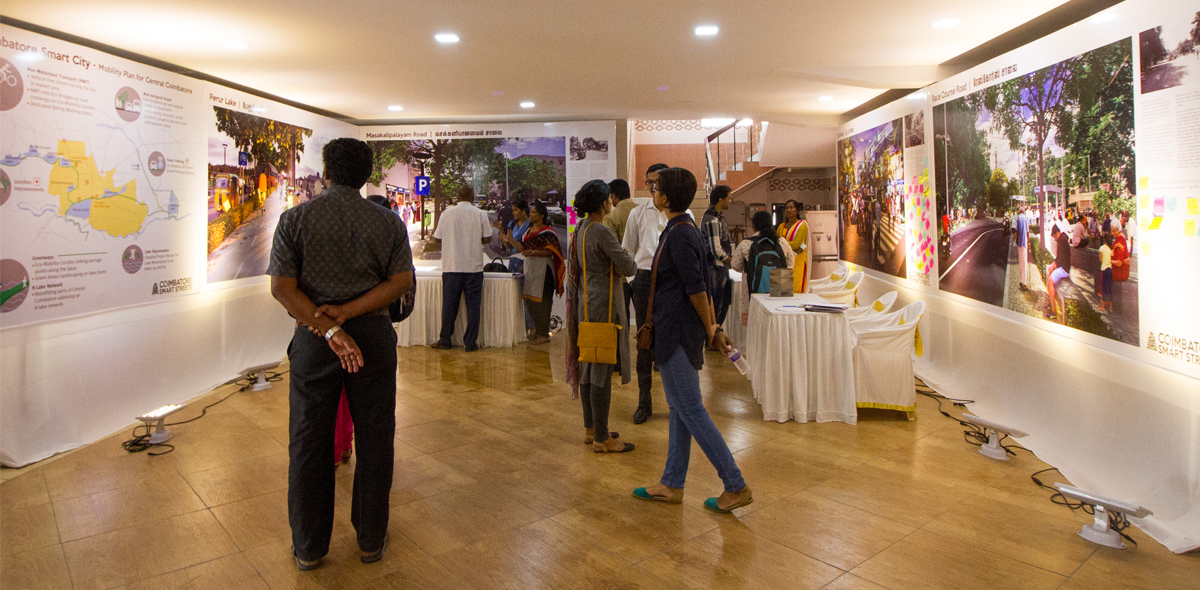
      The Coimbatore City Municipal Corporation organised the exhibition to inform the public in detail about the designs of the 6 Model Roads. People voiced their thoughts about the designs and the feedback collected will help shape the final designs of Coimbatore’s Smart Streets. The Coimbatore Street Design and Management Policy was also launched during the exhibition, marking an important milestone for the city!

      Coimbatore Smart Streets Exhibition 1

      The policy that has been adopted by the city, provides guidelines for the transformation of Coimbatore’s streets. Ambitious goals have been set to promote safe and equitable access for all users. These include increasing mode share of walking and cycling to at least 50% of all trips and that of public transport to 50% of all motorised trips in 15 years. The policy also aims to stabilise the number of vehicle kilometres travelled by personal motor vehicles (PMVs) by 2031, ensuring it does not exceed beyond 20% of the current figure.

      The Coimbatore Street Design & Management Policy was launched in the presence of the dignitaries of the day: Left to Right - Mr. Sandeep Nanduri IAS, Commissioner of Madurai City Municipal Corporation, Mr. T.K.Majumdar, Director, Internal Finance, Ministry of Urban Development, Mr. Prakash Govindasami IAS, Commissioner of Municipal Administration, Ms. Shreya Gadepalli, Director- South Asia, ITDP, Dr. K.VIjayakarthikeyan IAS, Commissioner of Coimbatore City Municipal Corporation, Ms. P.Gandhimathi, Deputy Commissioner, Coimbatore City Municipal Corporation

      The Coimbatore Street Design & Management Policy was launched in the presence of the dignitaries of the day: Left to Right – Mr. Sandeep Nanduri IAS, Commissioner of Madurai City Municipal Corporation, Mr. T.K.Majumdar, Director, Internal Finance, Ministry of Urban Development, Mr. Prakash Govindasami IAS, Commissioner of Municipal Administration, Ms. Shreya Gadepalli, Director- South Asia, ITDP, Dr. K.VIjayakarthikeyan IAS, Commissioner of Coimbatore City Municipal Corporation, Ms. P.Gandhimathi, Deputy Commissioner, Coimbatore City Municipal Corporation

      At the inaugural event, the Commissioner of Coimbatore City Municipal Corporation, Dr. K. Vijayakarthikeyan IAS, explained that Model roads, as the name suggests, are those streets that will be exemplary of the kind that Coimbatore will have in the future – a model to look up to. These streets will include high quality walking and cycling facilities, improved access to public transport, organised parking & vending zones and streamlined junctions.The Model Roads project is an initiative by the Corporation under the Smart Cities Mission, hence the coinage of the term ‘Smart Streets’.

      The Commissioner of Municipal Administration, Mr. Prakash Govindasami IAS delivered the special address at the event. “Everybody might not have a car, but we all have legs. We need to have the freedom to walk safely on the streets. And your voice should help make that happen”, stressed Mr. Prakash, explaining how the government inviting public participation in their initiatives, is the approach of this day and age.

      The public raised interesting opinions about the design of the streets, including requests to provide bus bays and entry/exit angles in parking bays. Advait Jani, Program Coordinator at the Institute for Transportation and Developmental Policy, replied, “Buses tend to move straight instead of making the turn into and out of a bus bay. Also, bus bays eat up much space – space that could otherwise be provided to pedestrians for walking. As to turning angles in parking bays, they benefit only the first and last slots in a bay. The splays work only in taxi bays as there is continuous movement and a queuing system is followed.”


      Coimbatore-Smart-Streets-Exhibition-2

      Another concern among the people was the absence of exit lanes at intersections, which might hinder with free flow of traffic. “Exit lanes are generally provided in highways where vehicles are expected to move fast and continuously, not at intersections on urban roads. Moreover, according to current traffic regulations, free lefts are forbidden. They are dangerous as well to the pedestrians crossing the road, and increase crossing distance”, said Advait Jani.

      The intersection testing that was conducted along with the exhibition, helped the architects and transportation experts explain the concept better. The junction of TV Swamy and DB Roads is proposed to become an iconic intersection with increased safety for all users. The proposed design creates a tighter intersection and thus reduced vehicle turning speed. This was tested out on-site for a period of four days, with space at all 4 corners of the intersection reclaimed for the pedestrians with exciting artwork.

      Coimbatore Intersection testing

      Following the exhibition, excavation has started on DB Road to allow for construction to begin soon. The Corporation has set a deadline of 3 months for the completion of DB and TV Swamy roads in the first phase of the project. Once constructed, these streets will become the pedestrians’ haven!


      Filed Under: Uncategorised Tagged With: Coimbatore, Community engagement, Sustainable Transport Policy, Walking and Cycling

      • 1
      • 2
      • Next Page »
      • Who We Are
        • Our Team
        • Contact Us
        • Opportunities
        • Our Approach
      • What We Do
        • Complete Streets and Parking Management
        • Public Transport
        • Transit Oriented Development
        • Inclusive Mobility
      • Where We Work
        • Agra
        • Ahmedabad
        • MAHARASHTRA
        • Pune – Pimpri-Chinchwad
        • Nashik
        • TAMIL NADU
        • Chennai
        • Coimbatore
        • JHARKHAND
        • Ranchi
        • NATIONAL
      • News
      • Resources
      • Get Involved
        • Donate

      Copyright © 2026 · ITDP Responsive on Genesis Framework · WordPress · Log in


      Loading Comments...